Flickr Widget

Showing posts with label Charles Eames. Show all posts

Monday, January 16, 2012

You look so familiar: Part 5 - Wings

Wings...from the subtle to the sublime, they make perfect ergonomic sense. They make perfect design sense too, because chairs in this style are considered some of the most lovely ever produced.

The previous installment of this series on the topic of shell chairs included a 1957 crossover piece by Hans Olsen that had small wing-style arms, but the design element appeared much earlier than that. Eero Saarinen and Charles Eames designed their Organic Chair in the late 1940s, and Eames capitalized on the design later with his DAX chair, which will be included in yet another category.

Harry Bertoia's svelte Bird Chair made subtle use of the feature, while Robin Day's spectacular Royal Festival Hall chair took modern seating to the brink of flight.

Charles Eames and Eero Saarinen Organic chair - 1940
loc.gov

Eero Saarinen Womb chair - 1948
treadwaygallery.com

Jupp Ernst chair by Helmut Lortz - 1950s
grainedit.com

Thonet - 1950s
1stdibs.com

Robin Day Royal Festival Hall chair - 1951
theargus.co.uk

Harry Bertoia Bird chair - 1952
knoll.com

Thursday, February 24, 2011

According to a Manufacturer: Is it real?

Last week I posted about the first article in a three-part series on the Jet Set Modern website. The second contributor to the article "Is It Real?" is William F. Berg of Modern Wood Works in Kenner, Louisiana. His company manufactures a line of shelving based on the design of Eames shelving units. (First post: According to a Collector)

Berg clarifies the laws concerning inventions and designs, explaining two types patents:

  • Utility patents - Protect inventors for 20 years. Charles Eames received a utility patent in 1942 for "A Method of Laminating Articles," which included the curved plywood chair.
  • Design patents - Keeps a designer from being copied for 14 years. Eames received one of these in 1948 for the LCW (Lounge Chair Wood).

Once these patents expire, they can not be renewed. At that point, it is entirely legal for any manufacturer to use the design and put his own label on the resulting product.

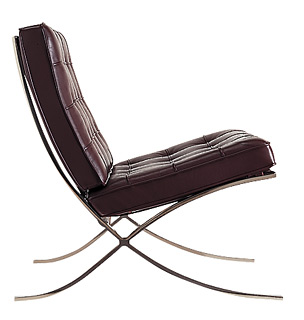
Trademarks, which include words, names or logos that identify a product, can be renewed. For example, Knoll, Inc. has exclusive rights to the word Knoll when applied to furniture. Knoll also has the rights to the term Barcelona. Once the patent on a design expires and it enters the public domain, anyone can manufacture the item but cannot call it by its trademark name. Hence, all the inventive names given to Barcelona chair look-alikes, such as "The Pamplona," which is a regular in Craigslist ads.

Berg answers the accusation that manufacturing or buying a reproduction is unethical or immoral by pointing out that most Americans feel fine about buying generic drugs. Most have made copies on machines that were not made by Xerox, and most have talked on telephones not tied by pedigree to Alexander Graham Bell. Looking at it that way, maybe we are cherry-picking our causes about which to be righteously indignant. 

Berg considers the terms knock-offreproduction and re-issue (both "authorized" and "unauthorized") to be little more than sales ploys to discredit legitimate competitors who are operating completely within the scope of patent and trademark laws. He says that if a company is honest, makes a good product true to the original design that meets your needs and makes it at a fair price, buy it.  He also reminds the reader that the original goal of the modern design movement was to make well-designed products affordable to the masses. 

So...can you tell these apart without looking a my sources?  One is a vintage Eames CSU, one is by Matt Blatt, and one is by Vitra.


The "authorized" version, 2011
vitra.com

Replica by Matt Blatt
mattblatt.com.au

The vintage Eames piece
treadwaygallery.com
Update: 4-19-2014 - The article that was originally on the Jet Set Modern site has been deleted, so I have removed the dead links from this post.

Sunday, January 9, 2011

Harry Bertoia

Harry Bertoia (1915-1978) was born in Italy. In 1930, he traveled to Detroit to visit his brother. Instead of returning home as he had planned, he remained in Michigan and enrolled in a technical high school for artistically gifted students. Eventually, he earned a scholarship to the Cranbrook Academy to study drawing and painting. After two years at Cranbrook, Bertoia was asked to direct the metal craft department and reorganize the metal shop, soon making metalcraft a popular program. Upon graduating in 1939, Eliel Saarinen, then director of the academy, invited Bertoia to join the faculty. Bertoia remained at Cranbrook until 1943.

Bertoia then moved to California to work with Charles and Ray Eames at the Evans Products Company, where Charles Eames worked as Director of Research and Development. There, they experimented with molded plywood technology in the service of the war effort. After Eames began to implement Bertoia's innovations without crediting him, Bertoia left.

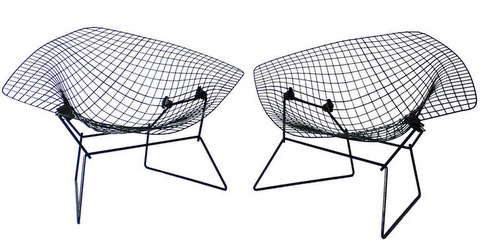
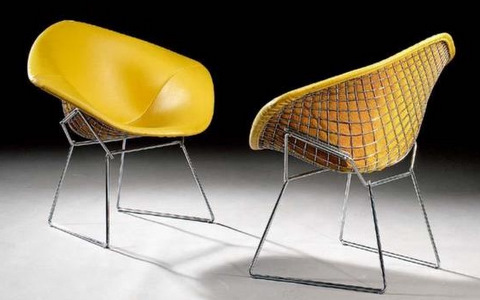
In 1950, Bertoia received an invitation from Hans and Florence Knoll to work as a designer for their well-known firm. Bertoia and his family relocated to Pennsylvania. By 1952, Bertoia had designed the famous "Diamond" seating collection, which included a lounge chair, stool, side chair, and a small chair for children. Constructed of industrial metal wire, the chair is remarkably strong despite its delicate appearance. Prized equally as a work of sculpture, it is still in production today and remains an icon of 20th century design.

Until his death in 1978, Bertoia was mainly active as a sculptor. Many of his sculptures are designed to move in the wind, some even to create sounds. He completed over 50 public sculptures in his lifetime, most notably for the chapel at the Massachusetts Institute of Technology and Dulles International Airport in Washington, DC. He was awarded the 1955 Fine Arts Medal, the 1956 AIA Craftsmanship Award, the 1968 Critics Award, and the 1973 AIA Gold Medal.

From lostcityarts.com and jonathanboos.com


Large diamond lounge chairs
1stdibs.com

Upholstered diamond chairs
authenticite.fr


Slat bench
1stdibs.com

Bar stools
1stdibs.com
Dining chairs
1stdibs.com

Dandelion sculpture
1stdibs.com

Sunday, January 2, 2011

Case Study House Program

In January of 1945, Arts & Architecture magazine announced the Case Study House Program. Several of the country’s most talented and innovative architects proposed to study, plan, design and construct eight houses in Southern California. Their mission was to gather a mass of material that would eventually define the post-war house.

The studies began with analysis of land in relation to work, schools, neighborhood conditions and individual family need. Each house was to be designed within a specified budget, and the architects were answerable only to the magazine, which posed as “the client” during the design phase.

The plan was to feature all eight of the houses in Arts & Architecture, with the architect(s) explaining the design and choice of materials. Upon completion, each house was to be open to the public for six to eight weeks. The houses would be completely furnished under a working agreement among the architect, the designer and the furniture manufacturer.

However, several of the designs remained unbuilt, because the architects had to find actual clients who could afford construction, since banks at that time were not yet loaning on flat-roofed modern houses. In all, 28 Case Study houses and two apartment buildings were built between 1945 and 1964.

Original 8 Case Study Houses

Number
Architect(s)
Year
Status
Location
Issue
1
J. R. Davidson
1948
Intact
North Hollywood, CA
Feb 1945
2
Sumner Spaulding, John Rex
1947
Intact
Arcadia, CA
May 1948
3
Wurster, Bernardi and Emmons
1949
Intact
Mandeville Canyon, CA
Aug 1947
4
Ralph Rapson

Unbuilt

Mar 1949
5
Whitney R. Smith

Unbuilt

Sept 1945
6
Richard Neutra

Unbuilt

Apr 1946
7
Thornton M. Abell
1948
Intact
San Gabriel, CA
Oct 1945
8
Charles Eames
1949
Intact
Pacific Palisades, CA
Jul 1948

From artsandarchitecture.com


Charles Eames House #8
you-are-here.com

Entenza House #9 by Charles Eames and Eero Saarinen
la.curbed.com

 #16 by Rodney Walker
artnet.com

Bailey House #20 by Richard Neutra
artnet.com

Stahl House #22 by Pierre Koenig
jennyhaniver.com

Thursday, September 16, 2010

Pioneers and prophets of modern design

While most people think "modern" means 1950 to the mid-1960s, the movement actually started two decades earlier.  Bauhaus visionaries like Marcel Breuer and Mies Van Der Rohe, as well as French designers Charles Edouard Jeanneret (Le Corbusier) and Charlotte Perriand were designing chairs in the 1920s that both predicted and influenced the departure from the stuffy conservatism of Victoriana.

In the 1930s Gilbert Rohde created tubular steel chairs for Herman Miller and Troy, and Alvar Aalto began to work with molded plywood. The 1938 sling chair designed by Jorge Ferrari-Hardoy became the classic Fifties "butterfly" design.  The rounded corners of Russel Wright's furniture for Conant Ball and his belief in mass-produced home decor changed the way furniture was made available to consumers.

The trio of chairs designed in 1940 by Charles Eames and Eero Saarinen won the MoMA Organic Design in Home Furnishings competition and reshaped our attitudes about the form and function of furniture.

After World War II, these chairs formed the vanguard of the mid-century modern movement and have been refined and repeated, copied and counterfeited, and faithfully revered ever since.


Wassily chair by Marcel Breuer, 1925
alginretro.com

Barcelona chair by Mies Van Der Rohe, 1927
knoll.com

Basculant "pony" chair by LeCorbusier and Charlotte Perriand, 1928
sillabarcelona.com

Molded plywood chair by Alvar Aalto, 1934
metmuseum.com
Tubular steel chair for Troy by Gilbert Rohde, 1930s
1stDibs.com

Russel Wright for Conant Ball
icollector.com

Lounge chair by Charles Eames and Eero Saarinen, 1940
moma.org