Flickr Widget

Showing posts with label George Nakashima. Show all posts

Thursday, June 26, 2014

The Nakashima legacy

Legendary furniture designer George Nakashima died in 1990, and his complex of home, studios and workshops in New Hope, Pennsylvania, were designated a National Historic Landmark. Nakashima's daughter, Mira Nakashima, took over the family business following her father's death.

Nakashima recalls living in a tent while her father built the family home and workshop. They used a cistern to collect rainwater, since they had no well. They got drinking water from neighbors and bathed where they swam.

Her father was trained as an architect, and she herself studied architecture at Harvard, but she has dedicated herself to the preservation of the complex and the furniture collections within the structures and to continuing the woodworking tradition her father started in the 20th century. She hopes her son Satoru will join the family business and carry it into the future.

From nowness.com


George Nakashima's home
nowness.com

Wood stored in the complex
nowness.com

Furniture stored in the complex
nowness.com

Current staff, with Mira Nakashima in the foreground
nowness.com

Monday, June 17, 2013

How designers live

While researching an upcoming post, I happened upon some extraordinary images of interiors of homes of well-known designers. The photographer, Leslie Williamson, has a spellbinding website that I urge you to visit. Her portfolio includes portraits of craftsmen and artists, as well as interior shots of beautiful spaces. What you see in this post are only a few of my favorites. I'm sure you will have favorites of your own.

All images from lesliewilliamson.com


Russel Wright's dining area - Garrison, NY

Vladimir Kagan's living room - New York City, NY

George Nakashima's Reception House - New Hope, PA

Irving Harper's bedroom - Rye, NY

Eva Zeisel's studio shelves - Rockland Co., NY
,
Charles and Ray Eames's studio - Pacific Palisades, CA

Walter Gropius's living room - Lincoln, MA

John Kapel's living room - Woodside, CA

Follow on Bloglovin

Wednesday, November 2, 2011

Vanishing art

Most of us are so accustomed to firing off a quick email from the computer at our utilitarian desks that we forget people in the mid-Twentieth century sat at exquisitely crafted pieces of furniture and composed letters by hand with elegant instruments called fountain pens.

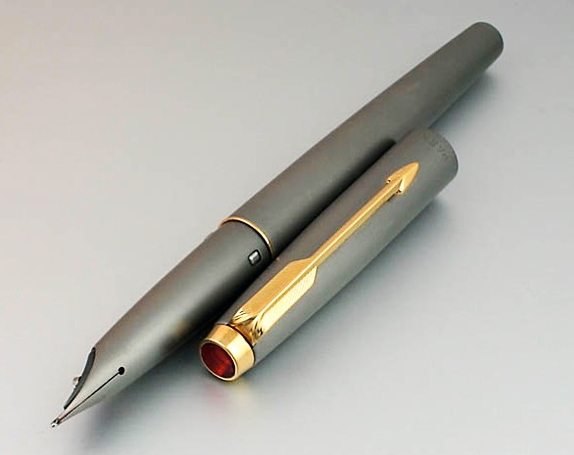
I hope these beautiful desks, along with a glimpse of an extremely rare Parker T-1, will inspire you to pick up a pen and write a note to someone you love.

Images from 1stdibs.com unless otherwise noted
Extremely rare titanium Parker T-1
fastcompany.com
Arne Vodder
Bullet-shaped Danish teak, designer unknown
Edward Wormley
George Nakashima
Hans Wegner
Ib Kofod-Larsen
Jens Risom
Kidney-shaped Danish with tambour doors, designer unknown
Milo Baughman
Nanna Ditzel
T. H. Robsjohn-Gibbings
Vladimir Kagan
Walnut desk with tambour doors, designer unknown

Sunday, June 26, 2011

Phillip Lloyd Powell

Phillip Lloyd Powell (1919-2008) was born in Germantown, Pennsylvania. He studied engineering at Drexel Institute of Technology (now Drexel University) before being drafted. During World War II he served as a weather forecaster for the Army Air Corps and was stationed in England.

After the war, he settled in New Hope, Pennsylvania. He bought a book on building houses and then constructed his own home.  In 1953 he opened a showroom in New Hope and sold Herman Miller furniture and Noguchi lamps.

My SIL discovered Powell's designs and told me about him. My first reaction was, "Wow, that's like a cross between Nakashima and Paul Evans." 

Much to my delight, I found that I was right on the money; he knew both men well. George Nakashima was a neighbor and was the person who encouraged Powell to start designing his own furniture, while Paul Evans was his protégé. In the mid-1950s, a 20-year-old Paul Evans came into Powell's shop and admired his work. Powell, 14 years Evans's senior, became his mentor. They shared a studio and worked together for roughly ten years, during which time they collaborated on furniture and accessories. (Powell shared an anecdote about taking the young Evans to Sears to buy tools. Evans was denied credit, so Powell had to get friends to donate tools so Evans could work.)

It is clear that Nakashima's work had a strong influence on some of his pieces, and he and Evans shared a love for metal and wood designs. However, other pieces have Powell's own unique sense of modernism...a sort of undulating, streamlined organic beauty that is his alone.

Powell's work is known for its beautiful hand carving and for its unique detail. Often his cabinets will open to reveal an interior of silver leaf or fine fabric. Sometimes he incorporated found objects or artwork into his pieces. For a more in-depth look at the man and his work, I found John Gehri Zerrer's site quite worth a look.

From nytimes.com and 1stdibs.com


Table, in collaboration with Paul Evans
1stdibs.com

Chair
1stdibs.com

Screen
artvalue.com

Table lamp
okoloweb.cz

Walnut and slate side tables
1stdibs.com

Sculpture
1stdibs.com

Sofa
1stdibs.com

Cabinet, with steel and gold leaf
1stdibs.com

Coffee table
1stdibs

Marble side tables
1stdibs.com

Sofa with marble table
christies.com

Powell at his New Hope home
jzerrer.com

This photo inspires a sense of wonder at Powell's magical silo home with the breathtaking door and spiral staircase he built by hand. However, it likewise evokes a bit of sadness, as Powell fell to his death from that staircase coming home late one night during a rainstorm in 2008. He was almost 90 years old at the time and had, from all accounts, lived a full and joyful life.

Wednesday, May 11, 2011

Embracing the wabi-sabi aesthetic

To restore or not to restore? That is the question lovers of mid-century modern design must answer often. We've debated this issue at great length and now tend to buy items for our homes and for the store that do not need major restoration. This is not to say that our pieces are flawless. Very few items survive sixty years without blemish. However, while some mid-century pieces have heavy wear that renders them almost unusable, others have only minor imperfections which tell a story about the previous owners who gently and lovingly used them. This sort of patina makes items all the more beautiful and needs no correction.

Wabi-sabi is a Japanese term fo an aesthetic that recognizes the transitory nature of life and the impossibility of perfection. It is sometimes described as a concept of beauty that is imperfect. Characteristics of wabi-sabi include simplicity, asymmetry and roughness or irregularity, especially that caused by time or use.

Mid-century designers espoused simple design and functionality. The spare designs of Charles and Ray Eames, Isamu Noguchi and George Nakashima embodied the simplicity of wabi-sabi and celebrated the beauty in everyday things. It stands to reason that they would have expected their pieces to show wear and signs of age after decades of use.

Mid-century experts today warn against unnecessary restoration. Richard Wright, director of the Wright auction house, gave an example in an interview with Troy Segal of a restoration that reduced the value of a rare Eames piece from $15,000 to $5,000. He says, "A real warning sign is if a piece is too band-box fresh, too gleaming. It should look a little worn, show its age--that's desirable."
From ratioblog.com, about.com and motherearthnews.com
The stark simplicity of the Eames home
motherearthnews.com
The imperfect shapes of Noguchi's Akari lighting
vitra.com
The natural irregularities of a Nakashima table
lostcityarts.com
A beautifully aged Hans Wegner high back lounge chair
1stdibs.com
Thonet chairs in unrestored condition
oneofakindantiques.com

Thursday, May 5, 2011

George Nakashima

George Nakashima (1905-1990) was born in Spokane, Washington, the eldest son of Japanese immigrants. He started at the University of Washington-Seattle as a forestry major but quickly changed to architecture and graduated in 1925. He then entered the Harvard Graduate School of Design but wanted an approach less theoretical than the program offered there and transferred to the Massachusetts Institute of Technology, where the emphasis was more on engineering. He received his Masters in Architecture in 1930.

In the late 1930s he worked in Tokyo for the architectural firm of Antonin Raymond. While there he became engaged to American Marion Okajima. They returned to the United States and were married in 1941. He went to work for the architect Ray Morin in Seattle, and there he first began making furniture in the basement of the Maryknoll Boys' Club, where he was given space in exchange for teaching the boys woodworking. It was at this time that Nakashima began his shift from architect to craftsman.

He had received a large commission from cosmetics magnate Andre Ligne, but his growing career was interrupted by World War II. From 1942-1943, Nakashima and his family were confined to the internment camp in Hunt, Idaho, but they were eventually allowed to leave under the sponsorship of Antonin Raymond and went to live on his farm in New Hope, Pennsylvania. Because of his recent internment, he was not allowed to work as a designer immediately. Instead he had to take care of the farm's chickens during the day and work on furniture at night.

In 1946 he was able to open his own studio on Aquetong Road, and his career began to grow. He enjoyed his greatest success during the 1950s through the 1970s. His signature pieces were large tables with smooth surfaces and unfinished natural edges. His style would change very little throughout his lifetime. He believed in meticulous, painstaking detail and the crafting of one-of-a-kind pieces in his studio, so he did very little work for mass production, with the exception of a few designs for Knoll and Widdicomb. One of his largest commissions was the design of over 200 pieces for Nelson Rockefeller.

He suffered a stroke in 1989, which diminished his technical ability, but he continued work up to his death rebuilding a collection for a couple who had lost the originals in a fire.

During his career, he received numerous prestigious awards, and his work has been exhibited in major museums around the country.

From pabook.libraries.psu.edu


Armchairs for Widdicomb
treadwaygallery.com

Bench
brcdesigns.com

Sofa
1stdibs.com

Peace Altar at Columbia University
warmemorial.columbia.edu

Lounge
thisnext.com

Coffee table
collectorsweekly.com

Sideboard
1stdibs.com

Armless lounge chairs
1stdibs.com