Flickr Widget

Showing posts with label clocks. Show all posts

Saturday, October 1, 2016

Spaces: Entryway

Once you get past our still-unpainted front doors (long story, soon to be rectified), you'll be greeted by more of our favorite things. The sideboard has sentimental value for my daughter. She found it at an estate sale years ago, and it was the first piece she ever restored. The vintage Von Nessen lamp came out of our store before it closed, and the brass figurals are part of my daughter's collection, while the Howard Miller Museum Clock is mine. The woven wall hanging and stainless steel coat rack are my daughter's, and the mirror is mine...new modern pieces that I think work well with the vintage. The picture on the wall is embroidered folk art, an Etsy find that I gave my daughter one Christmas.


Tuesday, September 18, 2012

The best laid schemes

In the words of the poet Robert Burns, for whom I have an affinity, "The best-laid schemes o' mice an' men gang aft agley." In Texanese (or Texlish, if you prefer, and I'm guessing in most of your translations too, unless you prefer the 1745 Scottish dialect) that line would read "The best laid schemes of mice and men often go awry."

However, I just realized that the plan for my clock wall went pretty darn well, even though I had forgotten that I had a plan. Huh? What does that mean?

I was looking at an altogether unrelated post a few minutes ago when a picture of a George Nelson eye clock showed up under You Might Also Like. The title of the post was "My Clock Quandary." I honestly didn't remember writing that post, so I clicked on the thumbnail to check it out.

It turns out that I had written that post in July of 2011...well over a year ago...about wanting a clock wall made up entirely of George Nelson designs. I had also written "Hold My Place" the following October about using reproduction pieces as place holders till I could find vintage clocks at a price I can afford.

Trust me, when you post daily for over two years, you don't remember everything you've written. Apparently my sub-conscious hadn't forgotten the posts though, because these were the clocks I used as examples of some of the ones I might choose:


Model #2238, the Eye Clock

Model #2239, the Spindle or Spool Clock

Model #2202, the Sunburst Clock

Model #2227, the Star Clock

Model #2261, the Sunflower Clock

Model #4756, the Steering Wheel Clock

Model #4775, the Pretzel Clock

Model #7552, one of the many Meridian designs

Model #7513-a, the Petal Clock

Model #7512, teak with birch markers


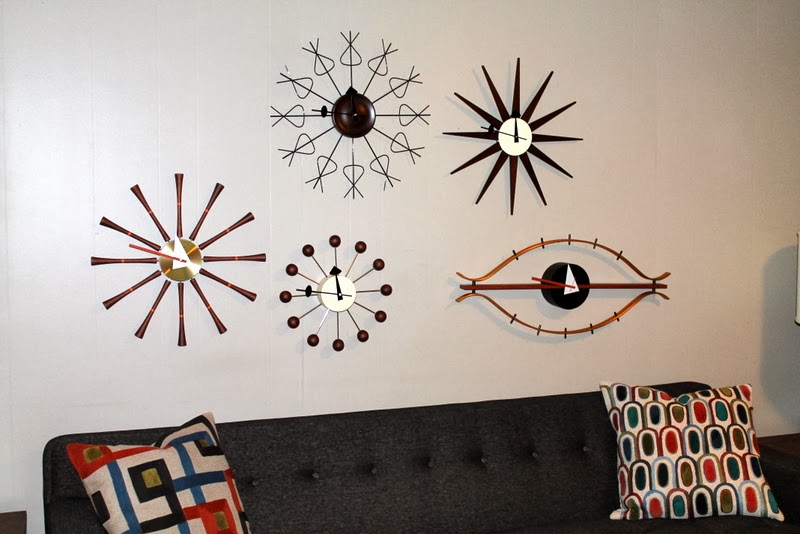
And this is the clock wall I put together:


Oddly enough, I recently made three offers on a steering wheel clock on eBay, but I must have insulted the seller. The first offer received a counter, but the other two weren't officially refused, just allowed to expire without any response at all. My motto has always been, "All they can do is say no." I guess they can just ignore you too. As a result, I went with the ball clock and have one clock on the wall that wasn't on my original list.

The only other variation from my original-but-forgotten plan is that I didn't put them in the spot I had initially picked out and had to buy more clocks than I first intended.

The wall is a great deal busier than I expected it to be, and I'm somewhat overwhelmed by it, but it's growing on me. Most of you who commented on my post about redecorating seemed to like the clock wall, so I'll give it a little more time. (That pun was accidental, really...but it's so bad it's almost funny, so I won't delete and rewrite.)

Tuesday, November 8, 2011

Harkerware clocks

Most people are familiar with Russel Wright's American Modern line by Steubenville and the Casual line by Iroquois. I've been asked which one of the two companies made the clocks for General Electric.

As a matter of fact, neither did. The ceramic clocks were part of the White Clover line by Harker Pottery that came out in the early 1950s. White Clover was available in Golden Spice, Meadow Green, Coral Sand and Charcoal.

Along with other American potteries, Harker was experiencing financial difficulties and only produced White Clover for five years. However, the clocks are still quite easy to find and are reasonably priced.

White Clover ad
modfather.com
Meadow Green
ease-antiques.com
Golden Spice
cozyantiques.com
Charcoal
cyberattic.com
Coral Sand
cozyantiques.com
White Clover clock ad
Better Homes and Gardens, November 1954
flickriver.com - Mr. McPants

Sunday, October 23, 2011

Hold my place

Some of you may have noticed that Nick from Mid-Century Midwest and I were having some difficulty receiving items we had ordered from The Foundary.

A couple of weeks ago they offered reproduction George Nelson clocks by Verichron at prices so low I couldn't afford to pass one up. I ordered the spindle clock (which I think is what Nick ordered too).

The delivery date we had been given came and went...and went...and went. Nick and I were calling the company almost daily to find out when our clocks were going to arrive and griping back and forth about it on our blogs. We weren't as upset as we would have been if we'd paid for vintage Nelson clocks that had tragically been lost in the mail. But we did expect to get the repros we spent our hard-earned money on!

Mine finally arrived yesterday, and I have to say that it more than met my expectations. I've said in several posts that I don't find reproductions as déclassé as some people do. In fact, I think they are perfectly fine if you're not a collector and just want a "look." I also think they're satisfactory place holders for collectors who are still looking for an affordable vintage piece, which is why I bought the clock. I'll keep scouring eBay and CL and auctions for a steal on a real Nelson clock, but in the meantime I'm rid of the cheesy mirror that was hanging in my alcove.

Obviously, the Verichron spindle clocks aren't Nelson twins, but neither are the Vitra re-issues, which cost almost $500. The vintage Howard Miller Model #2239 Spool/Spindle clock was 22.5" in diameter and had a black hour hand and a white minute hand. The spindle clocks currently sold by Vitra are 22.75" in diameter and have white hour hands and orange minute hands.

The Verichron spindle clock is only 19" in diameter, and it has a white hour hand and orange minute hand like the Vitra clock does. The only really unfortunate thing is that they printed "George Nelson" on the face. (Ack!) While it's obviously not the real thing, for the price I paid, it will do just fine till a vintage Nelson drops out of the sky into my lap.

Here's hoping that Nick's finally arrived too.


Vintage George Nelson spindle clock for Howard Miller
georgenelson.org

Vitra George Nelson re-issue
vitra.com

My Verichron repro

So much better, in my opinion, than
the Hobby Lobby mirror I had there!

Tuesday, September 13, 2011

Kitschy clocks

Before we became surrounded by clocks on microwaves, stoves, and the carry-it-wherever-you-go cell phone, kitchen clocks in the 1950s had a prominent place on the wall. They were usually colorful and sometimes tended to be on the cutesy side...what we now categorize as kitschy. For as long as I can remember, my grandmother had a green Dr Pepper clock in her kitchen exactly like the one in the photo below. Her father had owned a grocery store, which was later run by her brother, so I'm sure that's where it came from. I have a Russel Wright ceramic clock similar to the one in the Design Within Reach photo. Do you still have a kitchen clock, or do you consider them obsolete?

Here are several examples of vintage and reproduction clocks that are typical of what you'd find on kitchen walls back then.

retrotogo.com
amazon.com
ebay.com - fricknbrickn
amazon.com
dwr.com
etsy.com - oddznendz
mnmagine.com
ericwrobbel.com
icollector.com
retroon8th.com

Thursday, July 21, 2011

My clock quandary

I've decided I'd like a clock wall.  I already have the perfect spot picked out above the teak tea cart that I use as a bar. It's a small wall, so three clocks ought to be enough. When I first started to toss around the idea, the clocks in my mind's eye were generic mid-century models that I could pick up fairly inexpensively on eBay.

As the picture in my head started to come into focus, the George Nelson Eye Clock was always there, staring back at me, although I'm still not clear as to what the other two will be.  I spent some time last night reading about the Howard Miller clocks designed by George Nelson Associates.

The Nelson clocks began production in 1947, and it is estimated that there are over 150 designs.  The first was Clock 4755, now better known as the Ball Clock. The units were available with a cord or with a "Chronopak," which mounted in a standard outlet.

Howard Miller discontinued the line in the 1980s, and Vitra picked it up again in the 1990s. The original clocks were simply given model numbers, although many of them now have commonly accepted names. Most  were available in several colors. For example, the Ball Clock came in six variations, while the Sunflower Clock was available in three colors.  The clocks in the ceramic Meridian line had George Nelson hands but were made by Italian craftsmen and came in many styles and colors.

The most curious thing I read was that the model commonly known as the Eye Clock was shown in Howard Miller brochures hung diagonally, rather than horizontally. That bears more investigation. I've seen them hung vertically...but diagonally?

Text and images from georgenelson.org

Model #2238, the Eye Clock
Model #2239, the Spindle or Spool Clock
Model #2202, the Sunburst Clock
Model #2227, the Star Clock
Model #2261, the Sunflower Clock
Model #4756, the Steering Wheel Clock
Model #4775, the Pretzel Clock
Model #7552, one of the many Meridian designs
Model #7513-a, the Petal Clock
Model #7512, teak with birch markers

That only leaves 140 more choices.  So many beautiful clocks, so little wall space (and money).

Thursday, July 14, 2011

On the way to the store: George Nelson for Howard Miller

My SIL has been participating in some major auctions around the country lately, and a few days ago he won a clock by George Nelson for Howard Miller. I'm not talking about a small Nelson desk clock or even one of his larger wall clocks, but a floor model that's almost five feet tall.  It is in transit now from New York to Texas and should be in the store soon.

The clock is a sleek chrome and smoked Lucite grandfather style designed by Nelson in the 1960s. It stands 56" tall by 13" wide and will be a real eye-catcher in someone's modern home. I love the iconic George Nelson hands on the clock, and I've read that it has melodic chimes which ring on the hour and half hour. This is going to be so much fun to have in the store! (I can say this because it won't be waking me up all night on the hour and half hour. That might color my definition of fun just a bit. And, yes, my daughter, SIL and the boys are still living behind the store while they debate the merits of a house versus a high-rise apartment.) All that aside, I think the clock is destined to become one of those pieces we get attached to and don't want to give up.

1960s Howard Miller grandfather style clock by George Nelson

Friday, December 10, 2010

Jefferson clocks

The Jefferson Electric Mfg. Co. began in January of 1915. In 1931 the company moved to Bellwood, Illinois and started doing business at Jefferson Electric Company. They also opened a plant in Fall River, Massachusetts.

In the 1940s the first “mystery clock” that had no visible working parts was designed by Leendert Prins, a clockmaker from the Netherlands. This clock was called The Dutch Secret. Jefferson Electric purchased the rights for 
patent number 2,248,195 from Prins, who received royalties of 3.5 percent from the sale of each clock. They modified the design, and in 1949 they produced the Golden Hour, which originally retailed for $19.95. The Golden Hour was plated with 24K gold and had hands painted with radium paint, which is still radioactive. The use of this paint was banned in the mid-1960s.

Jefferson later produced other models, but the Golden Hour was the most popular. It remained in production until the clock division closed in August 1991. About two million of these were sold over the years.

From roger-russell.com


Front row (l to r): Golden View Mahogany, "500" Gold, "500" Chrome, Intermezzo, Lady Marion Gold,
Lady Marion Gray, Integer Gold, Integer Chrome, Golden View Blonde.
Back row (l to r): Golden Secret, Golden Helm, Golden Minute, Suspense,
Golden Hour, Exciting Hour, Contemporaire. ("880" not shown)
roger-russell.com


Golden Hour (l) and Golden Secret (r)
roger-russell.com

From Golden Hour manual
roger-russell.com

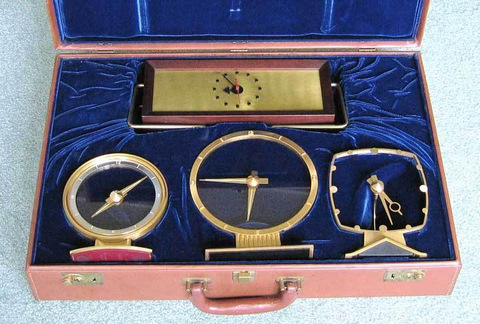
Vintage Jefferson Electric sample case
Bottom row (l to r): Golden Minute, Golden Hour, Golden Secret. Top row: Contemporaire.
roger-russell.com


The Golden Secret was designed and patented by Jan Walma, who was an acquaintance of Prins and is also from the Netherlands. It also was 24K gold plated and was sold by Jefferson in the USA. The Golden Secret had no glass at all.


Golden Secret
roger-russell.com


My daughter found a Jefferson "500" Chrome in perfect working order at an estate sale at another one of her ridiculously low prices. I was outbid on one the other day on eBay, but I'll eventually find one at an affordable price.


Jefferson "500" Chrome
hiandlomodern.com


Jefferson Electric ran a number of successful marketing campaigns. They sold a number of clocks to other companies to be used in promotions, and they ran print ads in magazines, such as Coronet and The New Yorker. One of these campaigns is knows as Four Men in Blue Blazers.


Rhapsody in Blue Blazers ad
roger-russell.com

Wanted for Stealing the Show ad
roger-russell.com

If you'd like more information about vintage clocks, audio equipment and much more, I encourage you to visit Roger Russell's site. The amount of research he has done for the site is truly impressive. I extend my sincere thanks to Mr. Russell for granting me permission to use information and images from his site, which are almost impossible to find elsewhere.