Flickr Widget

Showing posts with label Case Study Program. Show all posts

Sunday, October 23, 2016

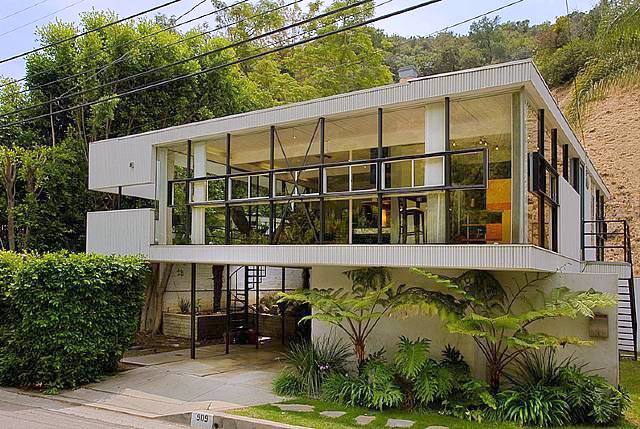
Famous Case Study House #21 for sale

Case Study House #21, immortalized by photographer Julius Shulman, is for sale. The asking price is $4,500,000. Known as the Bailey House, the 2 bedroom/2 bath 1280 sf home was designed by architect Pierre Koenig for psychologist Walter Bailey and his wife Mary in 1958 and was featured in the February 1959 issue of Arts & Architecture as part of the magazine's Case Study Program.

In 1997 the current owner of the home, film producer Dan Cracchiolo (of Matrix, Lethal Weapon and Conspiracy Theory fame), asked Koenig to supervise a complete restoration, as it had suffered many alterations over the years. The work was completed in 1999.

The house sits on a 12,450 sf lot in West Hollywood and has a spectacular canyon view.

From estately.com


Tuesday, October 16, 2012

Thornton Abell

Thornton Abell
Thornton Montaigne Abell (1906-1984) was a California-based architect. He was born in South Haven, Michigan, and educated at the University of Michigan, the University of California Berkeley and the University of Southern California where he graduated cum laude with a degree in architecture in 1931.

He worked as a designer for Clare C. Hosmer from 1925-1926, as a designer for Joseph J. Kucera from 1926-1927 and as a designer and chief draftsman for Marsh, Smith and Powell from 1930-1942. He opened his own office in 1944.

In 1947 he was asked to participate in the Case Study House Program. He designed and built Case Study House #7, which was completed in 1949.

From 1950-1952, Abell taught architecture and design at the Chouinard Art Institute in Los Angeles, and from 1953-1965 he taught at the University of Southern California's School of Architecture.

From washington.edu and soloarquitectura.com


Case Study House #7
housing.com

Case Study House #7
traceblog.com

Adelman Residence, with O'Neil Ford - Beverly Hills, California
crosbydoe.com

Alternate view of Adelman Residence
crosbydoe.com

Interior of Adelman Residence
crosbydoe.com

LeBrun House - Malibu, California
latimes.com

Interior of LeBrun House
latimes.com

Rich House - Brentwood, California
kristenkilmerdesign.com

Interior of Rich House
kristenkilmerdesign.com

Siskin House - Brentwood, California
mosslerproperties.com

Thornton Abell Residence - Santa Monica, California
californiahomedesign.com

Wednesday, September 5, 2012

Whitney R. Smith

Whitney R. Smith
Whitney R. Smith (1911-2002) was born in Pasadena, California. He received a bachelor's degree in architecture from the University of Southern California in 1934. Because there were few positions available in his field, he worked for a time building movie sets. He then worked for several architects, including Harwell Hamilton Harris, an early modernist whom Smith considered a strong influence on his work.

Smith opened his own practice in the early 1940s and was joined by Wayne R. Williams in 1946. Williams became a partner in 1949, and for the next 24 years, the firm of Smith and Williams created residences, schools, community buildings and recreational facilities that won state and national awards.

In 1946 Smith joined the Case Study House Program, designing Case Study House #5, known as the Loggia House, and Case Study House #12. Though neither house was built, they were considered two of the most experimental and innovative in the program.

From 1946 to 1950 Smith joined with A. Quincy Jones to design and build the Mutual Housing Association development, a large tract of houses in the Crestwood Hills neighborhood in Brentwood, a district in western Los Angeles. Also participating were architects Doug Honnold, John Lautner, Francis Lockwood, engineer Edgardo Contini and landscape architect Garrett Eckbo. However, because of their exposure in Arts & Architecture magazine while participating in the Case Study House Program, Jones, Smith and Contini eventually received full credit for the project.

Some of the projects of Smith and Williams were the Unitarian Church in Pasadena, the UCLA north campus student union and the UCLA Canyon Recreation Center, the central power building at Caltech, the dining facility and ancillary facilities at Camp Curry in Yosemite, the Griffith Park Girls Camp, the Santa Ana government center, the Buena Park Civic Center and the Japanese teahouse at Descanso Gardens in La Canada Flintridge.

In 1973 Smith left the firm of Smith and Williams and opened a private practice, designing the entrance complex and auditorium for the Huntington Library in San Marino, the Pasadena Neighborhood Church and the science building and the art studio and gymnasium at Westridge School for Girls in Pasadena. He retired in the mid-1980s.
Smith also taught architecture at USC and Scripps College in the 1940s and 1950s.

From latimes.com, housing.com, dwell.com


Evans house, with A. Quincy Jones
unstage.com

Alternate view of Evans house
nhit-shis.org

Schneidman house, with A. Quincy Jones
historichomesla.blogspot.com

Hamma house, with A. Quincy Jones
crosbydoe.com

Interior of Hamma house
takesunset.com

Pasadena home designed with Douglas Byles
homesbythegretchens.com

One of the original MHA homes, with A. Quincy Jones
corybuckner.com

Smith demonstrating moké (rhymes with OK), a method of weaving plywood to form intricate designs
dwell.com

Thursday, June 21, 2012

The houses that never were

We devotees of mid-century design spend countless hours looking at photos of famous Case Study Houses, many of which were immortalized by photographer Julius Shulman. But what about the Case Study Houses that were never built? These were designs architects spent months, even years, planning, drawing and promoting...time spent away from their families and putting other projects on the back burner, ultimately for naught, because they were unable to secure financing.

This happened more times than you might think. Of the original eight homes that were planned, three were never built. Case Study House #1 was designed in 1945 and remained unbuilt for three years, at which time the plans were drastically altered, resulting in a structure that barely resembled the original plans. So, in effect, half the original plans never came to fruition. Thirty-eight homes and apartments were finally designed for the project. Of those, only twenty-seven made it past the planning stage.

The chart below shows the Case Study Houses that were not built. Nevertheless, Arts & Architecture magazine ran articles about each one, to which I've provided links. You might enjoy taking a look at plans and photos of these houses that never came to be.

Number
Name
Architect(s)
Publication
Status
1
J. R. Davidson
Unbuilt
4
Greenbelt House
Ralph Rapson
Unbuilt
5
Loggia House
Whitney R. Smith
Unbuilt
6
Omega
Richard Neutra
Unbuilt
12
Whitney R. Smith
Unbuilt
13
Alpha
Richard Neutra
Unbuilt
19A
Don Knorr
Unbuilt
21A*
Richard Neutra
Unbuilt
24
A. Quincy Jones,
 Frederick E. Emmons
Unbuilt
27
Campbell and Wong
Unbuilt
Apt 2
Killingsworth, Brady,
Smith & Assoc.
Unbuilt
* In Arts & Architecture, this is called Case Study House #20. (The numbering of the Case Study Houses is so inexplicable that Esther McCoy, an undisputed expert on the subject, omitted them in her book Case Study Houses: 1945-1962.)

From artsandarchitecture.com

J. R. Davidson's Case Study House #1 (unbuilt)
thedesigncoop.com
Scale model of J. R. Davidson's Case Study House #1 (unbuilt)
artsandarchitecture.com

Wednesday, May 23, 2012

Craig Ellwood

Craig Ellwood (1922-1992) was born Jon Nelson Burke in Clarendon, Texas. His family moved to Los Angeles in 1937, and he graduated from Belmont High School in 1940 as Johnnie Burke. After World War II, he and his brother Cleve, along with two brothers named Marzicola, opened a contracting business they named the Craig Ellwood Company after a liquor store called Lords and Elwood, which was across the street from their office. (They added an L because they thought it sounded "swankier," and the name Craig just sounded cool to them.)

He later worked as a building cost estimator for the construction company Lamport Cofer Salzman in Los Angeles while attending night classes at the University of California Los Angeles, but he never completed his studies.

Burke legally changed his name to Craig Ellwood and opened Craig Ellwood Associates in Los Angeles in 1951. A real-life Don Draper, "Craig Ellwood" was a complete construct; Burke literally reinvented himself to become an architectural superstar, relying on charm, an eye for good design and sheer ambition. Since he was not formally trained as an architect, he provided the commissions and the vision, while he had to employ licensed architects to sign off on designs.

By 1952 he was chosen for the Case Study House 17B. His firm's designs were well received by the trade and clients, and he often received favorable coverage in influential publications like John Entenza's Arts & Architecture. He is also credited with Case Study House 18B and one done in 1953, which has no number.

Ellwood promoted himself like a Hollywood star. He had been an assistant publicist at the Hollywood Bowl, as well as a print model, continuing to appear in ads even after having some success with his architectural firm. He hired models and photographers to do photo shoots of his completed houses, and he marketed those photos worldwide.

Ellwood understood Hollywood and the value of promotion, because his wife Gloria had been a Hollywood studio actress. After their three children were born, she went back to work, playing the mother in the television series Dennis the Menace. In true Hollywood form, Ellwood drove Ferrarris and Lamborghinis and sponsored a race car in the Long Beach Grand Prix. Some called him "the Cary Grant of architecture."

Though never a licensed architect, he became a sought-after university lecturer, giving a series of talks at Yale University and teaching at University of Southern California and California State Polytechnic University.

Ellwood's firm expanded but was never particularly profitable, even though it was responsible for the master plan for the Rand Corporation headquarters in Santa Monica, California, as well as a number of Xerox and IBM offices. After closing his office, Ellwood retired to Italy.

From greatbuildings.com, arcspace.com, sduptownnews.com and wikipedia.org


Johnson/Stone House
homeasart.com

Interior of Johnson/Stone House
latimes.com

Kawahara Residence
la-curbed.com

Lipetz Home
takesunset.com

Rosen House
all-art.com

Bobertz Residence
modernsandiego.com
Moore House
latimes.com


Update (9-7-12): According to biographer  Neil Jackson in The Architecture of Craig Ellwood, Ellwood received his license from the State of California Board of Architectural Examiners on January 1, 1986.  His license number was C-16206. He obtained it as the result of a law passed on July 30, 1985. The law was intended to clarify the two-tier registration system by terminating the classification of Registered Building Designers and licensing all those thus registered as architects. As a result, Ellwood became an architect after he retired without ever passing the exams.