Flickr Widget

Showing posts with label Hans Knoll. Show all posts

Monday, June 6, 2011

Shu, Cranbrook and the roots of Knoll Associates

youtube.com
Uploaded by knolldesign, October 8, 2009

When Florence Schust (called "Shu" by her friends, as you will hear Richard Schultz refer to her in the video) saw Cranbrook Academy of Art, she knew it was the place she wanted to go to school. The campus, known as the birthplace of American modernism, was designed in 1928 by Eliel Saarinen and is comprised of ten Artist-in-Residence homes on one side of Academy Way and dormitories above graduate studios on the other side. The Academy's website provides several beautiful video tours of the campus today.

While a teenager and a student at the Kingswood School, a part of the 315-acre Cranbrook Educational Community, she met Eliel Saarinen and became an "unofficially adopted" member of the Saarinen family. During her years at Cranbrook Academy, she was immersed in a community of painters, sculptors, architects and designers, all working together to form an integrated concept. Later, when she married Hans Knoll, she brought Eero Saarinen, Ralph Rapson and Harry Bertoia...all from Cranbrook...into the company.

The magical beauty of Cranbrook, as well as the associations and friendships she formed there, no doubt influenced Florence Knoll's aesthetics and her vision of excellence for the company.

Saturday, April 2, 2011

Florence Knoll Bassett

Born Florence Schust (1917- ) in Michigan and orphaned at age 12, she later became a protegée of Eliel Saarinen at the Cranbrook Academy of Art, as well as a close friend of his son Eero. She also studied at the Architectural Association in London and under Mies van der Rohe at the Illinois Institute of Technology.

After receiving her degree, she moved to Cambridge, Massachusetts, where she worked briefly for Walter Gropius, Marcel Breuer and Wallace K. Harrison. In 1943, she went to work for the Hans J. Knoll Furniture Company, which at that time was a small studio mainly manufacturing pieces by Scandinavian designers. By 1946, she had become a full partner in the firm and married Hans Knoll. Together they formed Knoll Associates and began to focus on International Style Modernism.

Her innovative concept of "total design" resulted in the formation of a "space planning unit," which created cohesive, comprehensive design by encompassing architecture, manufacturing, interior design, textiles, graphics, advertising and presentation. This reinvented Knoll's image and revolutionized the field. Her ideas still remain in practice today.

She acquired the rights to produce Mies van der Rohe´s "Barcelona" group, as well as work from other well-known designers, including Eero Saarinen, Isamu Noguchi, and Harry Bertoia.

She became president of the firm in 1955, when Hans Knoll was killed in a car accident. She retired in 1960, but she is still a consultant. In 1958, she married banker Harry Hood Bassett.

In 2004, the Philadelphia Museum of Art devoted a major exhibit to her life and work.

From lostcityarts.com and knoll.com


Florence Knoll bench
knoll.com

Florence Knoll chair
knoll.com

Armless sofa
treadwaygallery.com

Oval desk table
knoll.com

Chrome and glass coffee and end tables
knoll.com

Florence Knoll sofa
knoll.com

Maple desk
metroretro.com

Sunday, January 9, 2011

Harry Bertoia

Harry Bertoia (1915-1978) was born in Italy. In 1930, he traveled to Detroit to visit his brother. Instead of returning home as he had planned, he remained in Michigan and enrolled in a technical high school for artistically gifted students. Eventually, he earned a scholarship to the Cranbrook Academy to study drawing and painting. After two years at Cranbrook, Bertoia was asked to direct the metal craft department and reorganize the metal shop, soon making metalcraft a popular program. Upon graduating in 1939, Eliel Saarinen, then director of the academy, invited Bertoia to join the faculty. Bertoia remained at Cranbrook until 1943.

Bertoia then moved to California to work with Charles and Ray Eames at the Evans Products Company, where Charles Eames worked as Director of Research and Development. There, they experimented with molded plywood technology in the service of the war effort. After Eames began to implement Bertoia's innovations without crediting him, Bertoia left.

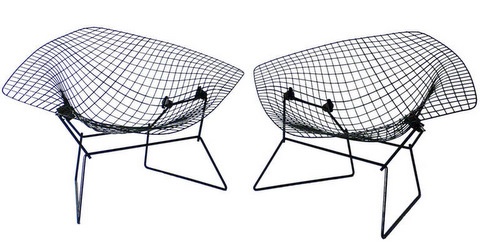
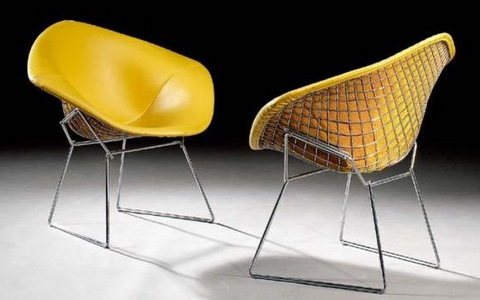
In 1950, Bertoia received an invitation from Hans and Florence Knoll to work as a designer for their well-known firm. Bertoia and his family relocated to Pennsylvania. By 1952, Bertoia had designed the famous "Diamond" seating collection, which included a lounge chair, stool, side chair, and a small chair for children. Constructed of industrial metal wire, the chair is remarkably strong despite its delicate appearance. Prized equally as a work of sculpture, it is still in production today and remains an icon of 20th century design.

Until his death in 1978, Bertoia was mainly active as a sculptor. Many of his sculptures are designed to move in the wind, some even to create sounds. He completed over 50 public sculptures in his lifetime, most notably for the chapel at the Massachusetts Institute of Technology and Dulles International Airport in Washington, DC. He was awarded the 1955 Fine Arts Medal, the 1956 AIA Craftsmanship Award, the 1968 Critics Award, and the 1973 AIA Gold Medal.

From lostcityarts.com and jonathanboos.com


Large diamond lounge chairs
1stdibs.com

Upholstered diamond chairs
authenticite.fr


Slat bench
1stdibs.com

Bar stools
1stdibs.com
Dining chairs
1stdibs.com

Dandelion sculpture
1stdibs.com

Sunday, October 31, 2010

Jens Risom

Jens Risom (1916- ) studied interior and furniture design at the Arts and Crafts Academy of Copenhagen, graduating in 1937. In 1939, he immigrated to the United States where he established himself as a proponent of the Scandinavian Modern style, which, at the time, had not yet achieved popularity.

That changed in 1940, when his design for a model house in New York's Rockefeller Center attracted widespread attention, generating both publicity and commissions, among them the distinction of being the first person invited to design furniture for Hans Knoll.

One of Risom's most recognizable designs is the birchwood chair (1941), which was made of molded birch and army surplus webbing. It is still in production today in a variety of colors. He is also known for his sculptural tables, chairs and sofas which had a lip that edged over an open base, giving the piece the illusion of floating.

After the Second World War, Risom founded his own furniture business, Jens Risom Design. He served as chief designer until 1973, when he sold his company to Dictaphone. He then moved to New Canaan, Connecticut, where he founded a consultancy studio called Design Control. It is still active.

From lostcityarts.com


Lounge chair
bonluxat.com

Bench
archiexpo.com

Credenza
1stdibs.com

Armchairs
1stdibs.com

Magazine table
1stdibs.com

3-seater sofa
1stdibs.com

Chair and ottoman
1stdibs.com

Love seat
1stdibs.com