Flickr Widget

Showing posts with label Harry Bertoia. Show all posts

Friday, July 29, 2016

How to spot an authentic Bertoia wire chair

The Bertoia wire chair is a mid-century icon. As such, it has been widely imitated. If having an authentic Bertoia chair is important to you...for its quality, its comfort, its retention of value, or simply for bragging rights...the Harry Bertoia Foundation has offered a guide for recognizing the real thing.

Details like wire diameter, the angle the wire is cut, the bend radius of the top corners and the base, and double wire rims on new chairs (although a few double rims were produced in 1953) are ways to spot a knock-off.

The tips in the article are quite specific, also providing information about glides, upholstery, line additions, and the Knoll stamp.

If you love the work of this mid-century designer, you'll want to check out the entire site for more information about the man himself, as well as his oeuvre. His daughter Celia Bertoia is director of the foundation, the mission of which is to spread the legacy of Harry Bertoia. On the website, you can become a volunteer, donate, or simply sign up for the mailing list.


Bertoia chair lineup
harrybertoia.org

Tuesday, March 10, 2015

Happy news on Harry's birthday

Harry Bertoia would have been 100 years old today. Appropriately, the Bertoia family and Important Records announced today that the Kickstarter project to raise money for the purchase of equipment necessary to save Harry's massive archive of Sonambient tape reels and release unheard works has been fully funded.

With 3 hours to go, 226 backers have raised $18,912, which exceeds the $15,000 goal.  I'm proud to have contributed, and there's still time for you to participate if you'd like.

From kickstarter.org


Friday, February 20, 2015

Help archive Harry

In 1960 Harry Bertoia accidentally struck a rod and was fascinated by the sound it made. From that time till his death in 1978, he experimented with tonal sculptures he called Sonambients. In a Pennsylvania Dutch fieldstone barn, he recorded more than 350 reels of tape and released eleven Sonambient LPs, the final creative masterworks of his lifetime.

The Harry Bertoia Foundation, Bertoia Studios and Important records currently have a Kickstarter project underway, hoping to fund the purchase of studio gear necessary to transfer the tape to electronic format.

I've contributed to the cause. If you're interested, you can get more information via the Kickstarter site.


Harry Bertoia and a few of his Sonambients
wright20.com


Here are a few of the gifts contributors can receive as a token of appreciation for their generosity.


Sonambient  tee
kickstarter.com

Sonambient poster
kickstarter.com

Bertoia Polaroid pack
kickstarter.com

50 Photos book (numbered edition of 500)
kickstarter.com

Saturday, January 25, 2014

Harry Bertoia Sculpture: 15 Years at Wright

For any of you lucky enough to be in New York in the next three weeks, there's an exhibition you might want to catch.

Wright Auctions is celebrating their history of selling the magnificent sculptures of Harry Bertoia by exhibiting select works, some of which they sold and some that have never been offered on the market. From Bush Forms, Welded Forms and Somnambients to experimental works, they will highlight exceptional pieces from Bertoia's extensive oeuvre.

The exhibition opened January 21 and will run through February 15 in their gallery at 980 Madison Avenue.

From wright20.com


Bush form
jonathanboos.com

Early bronze bush form, 1962
1stdibs.com

Close-up of bush form
1stdibs.com

Welded form
1stdibs.com

Welded form
liveauctioneers.com

Welded form
wright20.tumblr.com

Somnambient sounding sculpture
1stdibs.com

Somnambient sounding sculpture
liveauctioneers.com

Somnambient sounding sculpture
mutualart.com

Sunday, January 12, 2014

Harry Bertoia jewelry

Before Harry Bertoia ever designed his first piece of furniture, he studied jewelry and metalworking at the Cranbrook Academy. His designs became very popular in the local community, and he was asked by Charles and Ray Eames to design their wedding rings in 1941.

By the 1950s, Bertoia had become more interested in sculpture and industrial design. Today his original jewelry is rare, but the Harry Bertoia Store still reproduces his most popular pieces.

From modernica.com


Brooch
lamodern.com

Brooch
lamodern.com

Brooch
lamodern.com

Necklace
modernica.com

Earrings
modernica.com

Ring
weother.info

Sunday, August 18, 2013

In the store: The bird is the word

During the move, we didn't time to take pictures of new items in the store. After we got in, it took a few days to set up a photo booth, so we're playing catch-up these days. We hope you'll bear with us.

Well worth waiting for is this beautifully restored early Bird chair and ottoman by Harry Bertoia for Knoll. Very comfy!


Fully restored Bird chair by Harry Bertoia for Knoll


Such a cool profile

Front view of chair

Back view of chair

Wednesday, June 26, 2013

Harry Bertoia Centennial Table Tonal

Harry Bertoia (1915-1978) was a metal sculptor, jeweler, graphic artist, and furniture designer best known for the Knoll Bertoia wire chairs. His sounding sculptures were composed of a dense cluster of stainless steel rods welded to a base, which were "played" by running a hand along the top. Bertoia, along with his contemporaries Charles Eames, Eero Saarinen, George Nakashima and others, changed America’s approach to art and design.

For the first time, the Bertoia Estate now offers an exact reproduction of a tonal sculpture from Bertoia’s most popular style, which he and his son Val created together in the 1970s. The original stands with about a hundred other tonals in the Pennsylvania "Sonambient barn". (Somnambient was Bertoia's term to describe the spatial and tonal environment created by these sound sculptures.)


Harry Bertoia with some of his sculptures
dailyicon.com

Original large Bertoia Sonambient sculpture
1stdibs.com

Smaller original Sonambient sculpture
middlebury.edu

Bertoia barn - Barto, PA
lesliewilliamson.com


Check out the video. Celia Bertoia tells you a little about her father and lets you hear the Table Tonal. They are absolutely amazing, and I'd love for us to get one for the store!


Information about Bertoia and the new Table Tonal from Celia Bertoia
harrybertoia.org

Monday, January 28, 2013

In the store: Bird chair, Danish dining and lots of chrome

It frequently seems that we get an influx of several great new pieces at one time. The latest includes a newly powdercoated Bird Chair by Harry Bertoia for Knoll, a long Danish dining table with a set of chairs by Poul Cadovius, another Tobia Scarpa chrome plated steel and glass coffee table and a chrome chandelier.

We're having a charcoal colored pad made for the Bird Chair, so you'll be seeing it in its new duds soon. The Danish table is an impressive 94" dropleaf number that's a real stunner, and the Cadovius chairs speak for themselves.  In the past, we've sold an identical Scarpa coffee table, as well as the dining table from the same line, so we expect to sell this table easily. The chrome chandelier is very simple in design, but it packs a lot of glam.

Enjoy this look at our latest inventory additions.


Bird Chair by Harry Bertoia for Knoll

Danish dropleaf table and set of chairs by Poul Cadovius

Coffee table by Tobia Scarpa

Chrome chandelier (with a little peek at my SIL in the reflection)

Monday, January 16, 2012

You look so familiar: Part 5 - Wings

Wings...from the subtle to the sublime, they make perfect ergonomic sense. They make perfect design sense too, because chairs in this style are considered some of the most lovely ever produced.

The previous installment of this series on the topic of shell chairs included a 1957 crossover piece by Hans Olsen that had small wing-style arms, but the design element appeared much earlier than that. Eero Saarinen and Charles Eames designed their Organic Chair in the late 1940s, and Eames capitalized on the design later with his DAX chair, which will be included in yet another category.

Harry Bertoia's svelte Bird Chair made subtle use of the feature, while Robin Day's spectacular Royal Festival Hall chair took modern seating to the brink of flight.

Charles Eames and Eero Saarinen Organic chair - 1940
loc.gov

Eero Saarinen Womb chair - 1948
treadwaygallery.com

Jupp Ernst chair by Helmut Lortz - 1950s
grainedit.com

Thonet - 1950s
1stdibs.com

Robin Day Royal Festival Hall chair - 1951
theargus.co.uk

Harry Bertoia Bird chair - 1952
knoll.com

Monday, June 6, 2011

Shu, Cranbrook and the roots of Knoll Associates

youtube.com
Uploaded by knolldesign, October 8, 2009

When Florence Schust (called "Shu" by her friends, as you will hear Richard Schultz refer to her in the video) saw Cranbrook Academy of Art, she knew it was the place she wanted to go to school. The campus, known as the birthplace of American modernism, was designed in 1928 by Eliel Saarinen and is comprised of ten Artist-in-Residence homes on one side of Academy Way and dormitories above graduate studios on the other side. The Academy's website provides several beautiful video tours of the campus today.

While a teenager and a student at the Kingswood School, a part of the 315-acre Cranbrook Educational Community, she met Eliel Saarinen and became an "unofficially adopted" member of the Saarinen family. During her years at Cranbrook Academy, she was immersed in a community of painters, sculptors, architects and designers, all working together to form an integrated concept. Later, when she married Hans Knoll, she brought Eero Saarinen, Ralph Rapson and Harry Bertoia...all from Cranbrook...into the company.

The magical beauty of Cranbrook, as well as the associations and friendships she formed there, no doubt influenced Florence Knoll's aesthetics and her vision of excellence for the company.

Sunday, January 9, 2011

Harry Bertoia

Harry Bertoia (1915-1978) was born in Italy. In 1930, he traveled to Detroit to visit his brother. Instead of returning home as he had planned, he remained in Michigan and enrolled in a technical high school for artistically gifted students. Eventually, he earned a scholarship to the Cranbrook Academy to study drawing and painting. After two years at Cranbrook, Bertoia was asked to direct the metal craft department and reorganize the metal shop, soon making metalcraft a popular program. Upon graduating in 1939, Eliel Saarinen, then director of the academy, invited Bertoia to join the faculty. Bertoia remained at Cranbrook until 1943.

Bertoia then moved to California to work with Charles and Ray Eames at the Evans Products Company, where Charles Eames worked as Director of Research and Development. There, they experimented with molded plywood technology in the service of the war effort. After Eames began to implement Bertoia's innovations without crediting him, Bertoia left.

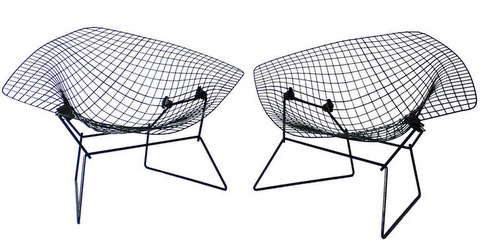
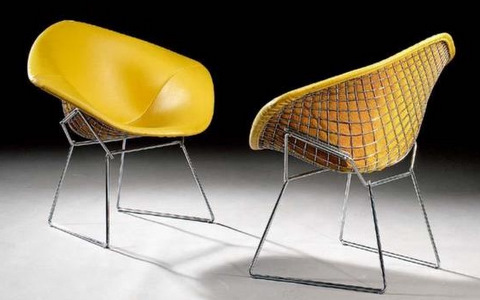
In 1950, Bertoia received an invitation from Hans and Florence Knoll to work as a designer for their well-known firm. Bertoia and his family relocated to Pennsylvania. By 1952, Bertoia had designed the famous "Diamond" seating collection, which included a lounge chair, stool, side chair, and a small chair for children. Constructed of industrial metal wire, the chair is remarkably strong despite its delicate appearance. Prized equally as a work of sculpture, it is still in production today and remains an icon of 20th century design.

Until his death in 1978, Bertoia was mainly active as a sculptor. Many of his sculptures are designed to move in the wind, some even to create sounds. He completed over 50 public sculptures in his lifetime, most notably for the chapel at the Massachusetts Institute of Technology and Dulles International Airport in Washington, DC. He was awarded the 1955 Fine Arts Medal, the 1956 AIA Craftsmanship Award, the 1968 Critics Award, and the 1973 AIA Gold Medal.

From lostcityarts.com and jonathanboos.com


Large diamond lounge chairs
1stdibs.com

Upholstered diamond chairs
authenticite.fr


Slat bench
1stdibs.com

Bar stools
1stdibs.com
Dining chairs
1stdibs.com

Dandelion sculpture
1stdibs.com

Monday, January 3, 2011

Ralph Rapson

Ralph Rapson (1914-2008) was an architect, designer and entrepreneur. He was educated at the University of Michigan and the Cranbrook Academy of Arts, where he studied under Eliel Saarinen. At Cranbrook he met Florence Schust, who would later marry Hans Knoll and then introduce him to the Knoll company, for which he would design a successful line in the 1940s.

Rapson taught architecture at the New Bauhaus School in Chicago from 1942-1946. He Also taught at the Massachusetts Institute of Technology from 1946-1954. He is well-known for his experimental concept houses like the 1939 "Cave House" and "Fabric House," and the 1945 "Greenbelt House," which was Arts & Architecture's Case Study House #4. Rapson was the Dean of the School of Architecture at the University of Minnesota from 1954-1984.

In 1963 he designed the Guthrie Theater in Minneapolis. He also worked for the U.S. Government's Department of Foreign Buildings in the 1950s, after striking a deal that any work he did would be furnished with Knoll furniture. From this period, Rapson is best known for the U.S. Embassy buildings in Stockholm and Copenhagen.

Rapson's furniture designs employed newly developed materials and mass production processes. In 1945 he helped Knoll introduce the 'Equipment for Living' series of furniture. The program was commissioned by the Kellett Aircraft Corporation, who requested that the pieces be made of metal. Rapson's line featuring a tea trolley, side table and lounge proved to be extremely successful, and Knoll created 'Thermalware' accessories like cocktail shakers and ice buckets to accompany the furniture. Knoll then released the Rapson Line in 1945, which included the now-classic "Rapson Rocker."  Knoll sold the playful, organic line to Bloomingdale's in 1945, who then took out a full page advertisement for the rocker in the New York Times, touting it as a modern take on a traditional piece.

Throughout the 1950s, Rapson and his wife Mary had a store, Rapson, Inc., in Boston. The couple sold Rapson's furniture, as well as George Nelson furniture and objects, Harry Bertoia jewelry and pieces from both the Knoll and Herman Miller collections. They also imported pieces that they found to be integral to the energy of modern design like porcelain from Germany and Marimekko textiles from Finland.

From r20thcentury.com and rapsonarchitects.com


Slide cart
rapsonarchitects.com

Slide rocker
rapsonarchitects.com 

Slide sofa and chairs
rapsonarchitects.com

Variation of slide rocker
rapsonarchitects.com

Slide lounge
rapsonarchitects.com

Slide lamps
rapsonarchitects.com

Slide lamp sketches
rapsonarchitects.com

Highback Greenbelt rock
rapson-inc.com