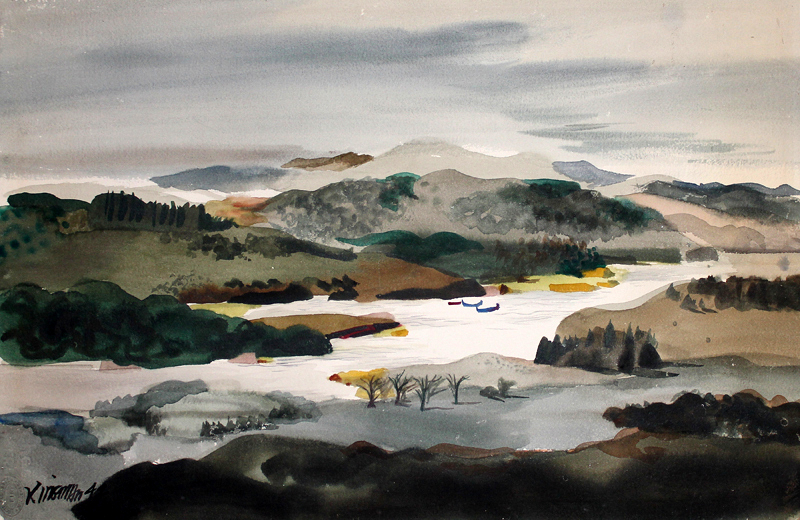
Dong Kingman (1911-2000) was born Dong Moy Shu in Oakland, California. At age five, his family moved to Hong Kong, where his father opened a business. When the boy started school and said he wanted to be an artist, his teacher, according to Chinese custom, gave him a new name: King (scenery) and Man (composition). After returning to the United States, he combined the two words into Kingman and, again following Chinese custom, used the family name first and the given name last.
While in Hong Kong, he studied under traditional Chinese watercolorists and Szeto Wai, a Paris-educated artist who introduced him to the Impressionists and to European trends.
In 1929 Kingman, then in his late teens, returned to Oakland, California. He attended the Fox Morgan Art School, held a variety of jobs and experimented with oils but decided to concentrate on watercolors. A 1936 solo exhibition at the San Francisco Art Association brought him instant success and national recognition.
During the Depression, Kingman was a participating artist in the Works Progress Administration (WPA) Art Project, which was created by the federal government to help support the arts. In the next five years, he painted prolifically for the relief program, and began to emerge as one of the country's leading artists and to take a place at the forefront of the California Style movement.
Kingman's bold paintings of the urban scene, which was to become his main subject, were considered by critics to be a synthesis of his Asian heritage and his fascination with Western modernism. Kingman agreed, saying, "I am Chinese when I paint trees and landscapes, but Western when I paint buildings, ships or three-dimensional subjects with sunlight and shadow."
In 1942, Dong Kingman was awarded a Guggenheim Fellowship, which enabled him to travel around the United States painting watercolors of American scene subjects. He went into military service during World War II and produced art for the war effort. After the war, he settled in New York, assuming teaching positions at Columbia University and Hunter College. His first one-man show in New York in 1942 was well received by the media. In 1951, Time magazine wrote, “At age 40, Kingman is one of the world’s best watercolorists.”
In 1954 Kingman became a cultural ambassador for the United States in an international lecture tour for the Department of State. He was also a founding faculty member of the Famous Artists Painting School of Westport, Connecticut, joining artists such as Ben Shahn, Norman Rockwell and Stuart Davis on the faculty.
Kingman became involved in the film industry during the 1950s and 60s. His watercolors were used in the films
Flower Drum Song (Universal, 1961) and
55 Days At Peking (Allied Artists, 1963), both giving the artist film credit. He served as technical advisor for
The World of Suzie Wong (Paramount, 1964) and contributed his artwork to motion pictures including
Circus World (Paramount, 1964),
King Rat (Columbia, 1965),
The Sand Pebbles (20th Century Fox, 1966),
The Desperados (Columbia, 1969) and
Lost Horizons (Columbia, 1973). Over three hundred of his film-related works are permanently housed at the Fairbanks Center for Motion Picture Study at the Motion Picture Academy's Margaret Herrick Library in Beverly Hills, California.
In addition to many honors and awards, as well as corporate and private commissions, Kingman's paintings are part of collections of over 50 major public American museums and institutions. They include the Art Institute of Chicago, The Brooklyn Museum of Art, Butler Institute of American Art, Fred Jones Jr., Museum of Art at the University of Oklahoma, the Frye Art Museum, the M. H. de Young Memorial Museum of Art, the Metropolitan Museum of Art, the Museum of Fine Arts in Boston, the Museum of Modern Art in New York, the Pennsylvania Academy of Fine Arts, the San Diego Museum of Art, the Springfield Art Museum and the Toledo Museum of Art.
From calart.com and dongkingman.com
 |
442 Combat Team in Leghorn
history.army.mil |
 |
Waterfront
sfmoma.org |
.jpg) |
Brooklyn
sacksfineart.com |
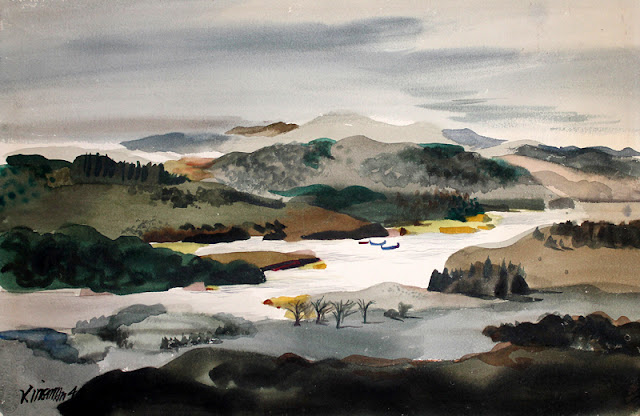 |
River Valley
annexgalleries.com |


.jpg)