Flickr Widget

Showing posts with label California Modern. Show all posts

Saturday, October 4, 2014

Esther McCoy

Esther McCoy (1904-1989) was an author, lecturer, screenwriter, architectural preservationist and exhibition curator. She is probably best known as one of the foremost architectural writers of the 20th century.

McCoy was originally a fiction writer, also working as a researcher for Theodore Dreiser, but she turned to architectural writing after working as a draftsman for Rudolf Schindler and learning about Southern California Modern architecture.

Her book Five California Architects, written about Bernard Maybeck, Irving Gill, Charles and Henry Greene, and Rudolf Schindler, was the first work to bring the California Modernism movement to the attention of a large audience.

McCoy contributed to John Entenza's Art & Architecture, as well as Architectural Forum and Architectural Record and also wrote Blueprints for Modern Living, a history of the Case Study homes.

From grahamfoundation.org, latimes.com and kcet.org


Cover of Five California Architects
kcet.org

Esther McCoy's home in Ocean Park, California
kcet.org

Julius Shulman photo of Esther McCoy
eastofborneo.org

Esther McCoy in Mexico, 1952
awaplusd.org

Monday, February 7, 2011

Required reading


Several books, both old and new, have made it onto my "Required Reading" list as I search for information about all things mid-century. Some I've had for years, and I still refer to them frequently. Some are recent acquisitions that I'm sure will be just as helpful. The ones I couldn't do without include:
  • Mid-Century Modern: Furniture of the 1950s by Cara Greenberg - This book, written by the person credited with coining the term "mid-century modern" in 1984, has proven to be one of the most valuable books I have.
  • Collector's Encyclopedia of Russel Wright by Ann Kerr - This is the final word on Russel Wright. Ann Kerr is my hero. We ran across an autographed copy last year but sold it in our booth, and I've regretted it ever since.
  • Guide to Easier Living by Mary and Russel Wright - First published in 1950, this book gives a priceless look into the mid-century concept of informal living.
  • Modern Retro: Living with Mid-Century Modern Style by Neil Bingham & Andrew Weaving - I carry the pocket edition around in my purse!
  • Modern Retro Table Style by Madeleine Marsh - Containing some of the most beautiful pictures of mid-century tableware I've ever seen, this book has something new for me every time I look through it. Today I was surprised to find several pages on Midwinter tea sets, which I'd never noticed before.
  • Retro Modern by Lisa Skolnik - The author of this book captures the architecture, the unique room design and what she calls "prime pieces" of mid-century furnishings.
  • Atomic Ranch: Design Ideas for Stylish Ranch Homes by Michelle Gringeri-Brown and Jim Brown - I love the magazine. I love the book.
Other books I never tire of looking through are Forgotten Modern: California Houses 1940-1970 by Alan Hess and Alan Weintraub, Cliff May and the Modern Ranch House by Daniel P. Gregory. Since the price has come down from $200 to $125 since Christmas, I'm hopeful that I'll eventually be able to afford a copy of the Marilyn Neuhart 2-volume book The Story of Eames Furniture.

My latest purchase was The G-Plan Revolution: A Celebration of British Popular Furniture of the 1950s and 1960s by Basil Hyman and Steven Braggs. You may be quite familiar with the other books I mentioned, but I'll share this one with you, since it might not be on your shelves yet. (I bought it because we purchased several pieces of G-Plan, Nathan and Remploy furniture not long ago, and I wanted to become more familiar with British mid-century furniture before talking to customers about it.)

An unusual book inside and out, it's a hardcover edition which has been hole-punched as if to fit into a binder. On the inside are excellent reproductions of primary sources. Instead of simply including photos from all the brochures they found while researching G-Plan furniture, they actually reproduced several of the old brochures and bound them into the book. The illustrations, for the most part, are scanned straight from magazines and newspaper ads, making the reader feel as though he's thumbing through the original pages. The format is fun, and the information is excellent. I love this book! Take a look.


I'll post more about G-Plan in a few days, and eventually we'll photograph all the furniture we've bought recently, so I'll be able to post about it too. I know some of you are still waiting for that one, since I inadvertently published an unfinished post about it that I had to pull.

Tuesday, November 16, 2010

Milo Baughman

After studying architecture and product design at the Art Center School of Los Angeles and the California School of the Arts, Milo Baughman (1923-2003) took a job with the Frank Brothers department store as a salesman and a window dresser. On the side, he became involved with the influential publication Furniture Forum.

Glenn of California hired Baughman to design a new collection. Working mainly with walnut, Formica and wrought iron, Baughman created simple, understated pieces; many were conceived as space dividers, functioning admirably in the open plan interiors characteristic of the California Modern style.

In addition to Glenn of California, Baughman designed for a number of furniture companies starting in the mid-1940s until his death, including Mode Furniture, The Inco Company, Pacific Iron, Murray Furniture of Winchendon, Arch Gordon, Design Institute America, George Kovacs, Directional, Henredon and Drexel, among others. He is most famous, however, for his longtime association with Thayer Coggin of High Point, North Carolina.

After briefly running his own workshop, Baughman began a long association in 1953 with Thayer Coggin, a North Carolina furniture company that lasted until his death in 2003. His stylish furniture proved very popular with middle class consumers, and he quickly became a household name. Among his noteworthy designs for the company are the 820-400 chaise (1954) and the leather and chrome 951-103 arm chair (1962).

In 1969 he was invited by Brigham Young University to establish a Department of Environmental Design, where he continued as chairman and adjunct professor for several years, while continuing his design business. He moved to Virginia for twelve  years and later returned to BYU as a senior lecturer. He also lectured over the years at the Rhode Island School of Design, the Univertity of Wisconsin-Madison and the University of Tennessee.

Baughman’s work was included in the Whitney Museums 1985 exhibit High Styles: Twentieth Century American Design. In recognition of his monumental impact on American taste, Baughman was inducted into the Furniture Designers Hall of Fame in 1987.

From lostcityarts.com, deseretnews.com and artnet.com


Desk for Glenn of California, 1949
1stdibs.com

Credenza for Glenn of California, 1950s
1stdibs.com

Scoop chair for Glenn of California, 1952
redmodernfurniture.com

Drexel Perspective sideboard, 1952
1stdibs.com

820-400 chaise for Thayer Coggin, 1954
dallasmodern.net

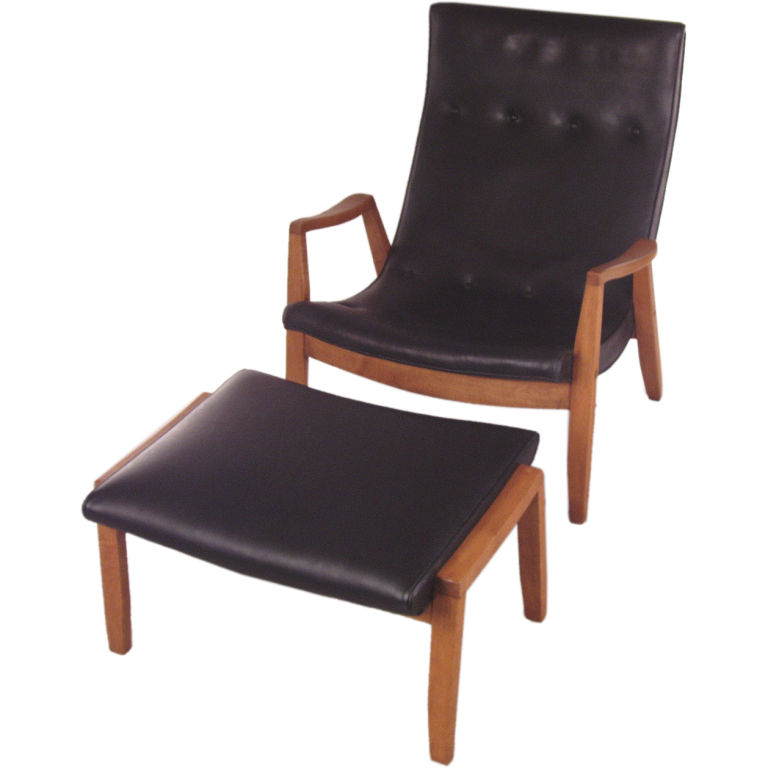
Lounge chair and ottoman for Thayer Coggin, 1950s
1stdibs.com

951-103 arm chair for Thayer Coggin, 1962
eddenton.com

Sectional and tables for Thayer Coggin, 1960s
antiquesmoderne.com

Lazy susan coffee table for Thayer Coggin, 1960s
Groovy Treasures (Antique Gallerry), Lewisville, TX
I saw this Thayer Coggin table at an antique mall near me over the weekend,
and it was pretty impressive.  The seller is asking $750 for it.