Flickr Widget

Showing posts with label Pomona Tile. Show all posts

Sunday, September 20, 2015

Part 2: How bad is too bad?

Remember when I asked in a post a few days ago if a house could skip "bad" and go straight to "too bad"? After making an appointment to see said house, here is what we found upon entering.

We were a little surprised that the sellers hadn't made even the most minimal effort to clean out the house. It would quite literally take a crew with a dump truck to get rid of all the detritus that was left behind when the previous owner vacated. That's probably one of the reasons it's been sitting on the market for 170 days.


The verdict: It is a lot cooler than we had expected...and in worse shape than we thought, inside and out. In addition to the mounds of trash and abandoned personal belongings, we found obvious water damage, possible mold, and general dilapidation of wood and stone structures outside.


Still, we haven't ruled it out, if for no other reason than that both bathrooms have vintage Pomona tile designed by George Nelson sometime in the late 50s or early 60s for the Distinguished Designer series (which included tiles by Paul McCobb, Millard Sheets, Dorothy Liebes, Saul Bass, Paul Laszlo, and Dong Kingman). At some point, the top of the vanity in one bathroom was replaced with marble, but I found a lot of 76 of the tiles on Ebay, and failing finding the same tile later, we could always have it tiled with a complementary untextured tile. (Yes, I'm already starting to obsess.)


ebay.com

Thursday, July 4, 2013

Millard Sheets

Millard Sheets (1907-1989) was born in Pomona, California. He graduated from Chouinard Art Institute in 1929. Even before he finished his formal education, the California Water Color Society hired him to teach watercolor painting.

By the early 1930s, Sheets had already gained national recognition. He was exhibiting works in Paris, New York, Pittsburgh, Chicago, Houston, St. Louis, San Antonio, San Francisco, Washington, D.C. and Baltimore and was recognized as the leading figure in the California Style watercolor movement.

During the Depression, Sheets worked to hire artists for the Works Progress Administration (WPA) Art Project. Later during World War II, he was an artist correspondent for Life magazine and the Army Air Force in India and Burma. The famine and death he witnessed there were reflected in the dark colors and themes of some of his works immediately after the war, but by the 1950s, he was using bright colors.

Sheets was a versatile artist, producing murals, sculpture, stained glass and interiors, in addition to his paintings. His art work has been widely exhibited in many museums, including the Museum of Modern Art and the Whitney Museum in New York City, the Art Institute of Chicago and the Los Angeles County Museum of Art. Among the more than 150 murals he executed are works at the University of Notre Dame and in the dome at the Cathedral of the Immaculate Conception in Washington, D.C.

While Sheets was a talented painter in both watercolors and oils, this was only part of his overall art career. Through his directorship of the Scripps College Art Department, the Claremont Graduate School Art Department and the Otis Art Institute, he taught hundreds of artists how to paint, and then guided them into art careers. He also worked as an architect, illustrator, printmaker and juried art exhibitions.

A huge Sheets mural depicting the Battle of the Alamo made news in Texas in 2011 when the San Antonio Independent School District sold a building containing the 20' x 32' mural without even mentioning it in the listing. The company who bought the building had no idea they were getting a piece of art worth $200,000-400,000 in the transaction.

From publicartinla.com, millardsheets.net and parkitecture.org


Moonlight at Barking Rocks
allartnews.com
Padua Olive Hills Drive
otis.edu

Gaviota Range
bodegabayheritagegallery.com

Gypsy Camp
millardsheetspaintings.com

Afternoon, Hookena Beach, Hawaii
millardsheets.net

Death of Travis
Found in a building sold by the San Antonio ISD
parkitecture.org

Bahama Reef tile by Millard Sheets
from a Pomona Tile Manufacturing Company brochure
cathyofcalifornia.typepad.com

Friday, June 28, 2013

Dorothy Liebes

Dorothy Liebes (1897-1972) grew up in Santa Rosa, California. After finishing high school, she taught art for one year, then studied anthropology, art and teaching at San Jose State Teacher's College and at the University of California at Berkeley, where she received a degree in 1921. While there she was encouraged to pursue weaving, so she bought a small portable loom and taught herself.

She then studied weaving and design, first at Hull House in Chicago and then at Columbia University and the California School of Fine Arts. By selling small handwoven articles, she earned enough money to visit European museums and weavers.

In 1928 she married Leon Liebes, a businessman who sponsored several young artists. He gave his wife studio space in the building that housed his store and encouraged her to experiment. Her first group show was in 1933 at the Decorator's Club in New York City. In 1934 she started Dorothy Liebes Design, Inc., of San Francisco and received her first major commissions from the Ahwahnee Hotel in the Yosemite Valley and the San Francisco Stock Exchange Club.

She was named director of the influential Fine Arts Exhibit of the 1939 San Francisco World's Fair, and began winning awards and having shows in the United States and abroad.

In 1940 she and Leon Liebes divorced. In 1948 she married Pulitzer Prize-winning journalist Relman Morin, but she retained the surname of Liebes professionally.

When Liebes began weaving, most weavers were only producing standard cloth, such as twill, plain weaves and damasks of cotton, wool, silk or linen. But Liebes saw weaving as an art and used not only yarn but also strings of beads, strips of bamboo, cellophane, leather, metallic threads, straw and metal rods. She also used unconventional colors, such as lacquer red, chartreuse, fuchsia, tangerine and turquoise. She said, "There are no bad colors, only bad combinations of colors."

She created colorful window shades, rugs, upholstery fabric and draperies, as well as sculptural weavings. Her weaves became the standard complement to modern architecture, and she became known as "the mother of modern weaving." She was commissioned by architects Frank Lloyd Wright, Edward Durell Stone and Samuel Marx, and she was a design consultant for companies such as DuPont and Dow, assisting in the development of machinery that could replicate the aesthetic irregularities of hand-loomed fabrics.

From whoislog.info and Notable American Women: The Modern Period: a Biographical Dictionary, edited by Barbara Sicherman and Carol Hurd Green


Textile sample
metmuseum.org

Textile sample
metmuseum.org

Textile sample
metmuseum.org

Textile sample
metmuseum.org


Textile sample
metmuseum.org

Window blind sample
metmuseum.org

Window blind sample
metmuseum.org

Window blind sample
metmuseum.org

Window blind sample
metmuseum.org

Window blind sample
metmuseum.org

Window blind sample
aaa.si.edu

Window blind sample
metmuseum.org

Kashmir tile for Pomona Tile Manufacturing Company
1stdibs.com


Google Reader shuts down on July 1, 2013.
Follow on Bloglovin

Friday, June 21, 2013

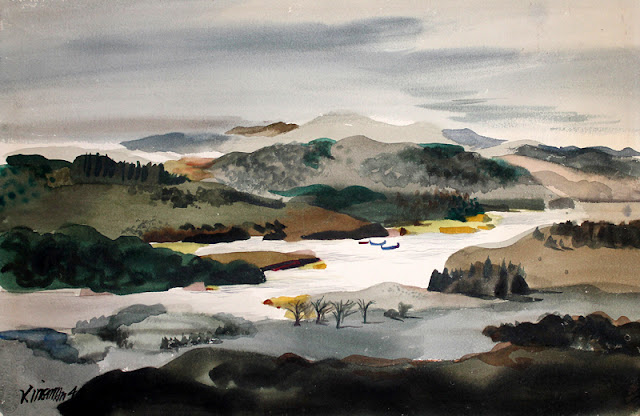
Dong Kingman

Dong Kingman (1911-2000) was born Dong Moy Shu in Oakland, California. At age five, his family moved to Hong Kong, where his father opened a business. When the boy started school and said he wanted to be an artist, his teacher, according to Chinese custom, gave him a new name:  King (scenery) and Man (composition). After returning to the United States, he combined the two words into Kingman and, again following Chinese custom, used the family name first and the given name last.

While in Hong Kong, he studied under traditional Chinese watercolorists and Szeto Wai, a Paris-educated artist who introduced him to the Impressionists and to European trends.

In 1929 Kingman, then in his late teens, returned to Oakland, California. He attended the Fox Morgan Art School, held a variety of jobs and experimented with oils but decided to concentrate on watercolors. A 1936 solo exhibition at the San Francisco Art Association brought him instant success and national recognition.

During the Depression, Kingman was a participating artist in the Works Progress Administration (WPA) Art Project, which was created by the federal government to help support the arts. In the next five years, he painted prolifically for the relief program, and began to emerge as one of the country's leading artists and to take a place at the forefront of the California Style movement.

Kingman's bold paintings of the urban scene, which was to become his main subject, were considered by critics to be a synthesis of his Asian heritage and his fascination with Western modernism. Kingman agreed, saying, "I am Chinese when I paint trees and landscapes, but Western when I paint buildings, ships or three-dimensional subjects with sunlight and shadow."

In 1942, Dong Kingman was awarded a Guggenheim Fellowship, which enabled him to travel around the United States painting watercolors of American scene subjects. He went into military service during World War II and produced art for the war effort. After the war, he settled in New York, assuming teaching positions at Columbia University and Hunter College. His first one-man show in New York in 1942 was well received by the media. In 1951, Time magazine wrote, “At age 40, Kingman is one of the world’s best watercolorists.”

In 1954 Kingman became a cultural ambassador for the United States in an international lecture tour for the Department of State. He was also a founding faculty member of the Famous Artists Painting School of Westport, Connecticut, joining artists such as Ben Shahn, Norman Rockwell and Stuart Davis on the faculty.

Kingman became involved in the film industry during the 1950s and 60s. His watercolors were used in the films Flower Drum Song (Universal, 1961) and 55 Days At Peking (Allied Artists, 1963), both giving the artist film credit. He served as technical advisor for The World of Suzie Wong (Paramount, 1964) and contributed his artwork to motion pictures including Circus World (Paramount, 1964), King Rat (Columbia, 1965), The Sand Pebbles (20th Century Fox, 1966), The Desperados (Columbia, 1969) and Lost Horizons (Columbia, 1973). Over three hundred of his film-related works are permanently housed at the Fairbanks Center for Motion Picture Study at the Motion Picture Academy's Margaret Herrick Library in Beverly Hills, California.

In addition to many honors and awards, as well as corporate and private commissions, Kingman's paintings are part of collections of over 50 major public American museums and institutions. They include the Art Institute of Chicago, The Brooklyn Museum of Art, Butler Institute of American Art, Fred Jones Jr., Museum of Art at the University of Oklahoma, the Frye Art Museum, the M. H. de Young Memorial Museum of Art, the Metropolitan Museum of Art, the Museum of Fine Arts in Boston, the Museum of Modern Art in New York, the Pennsylvania Academy of Fine Arts, the San Diego Museum of Art, the Springfield Art Museum and the Toledo Museum of Art.

From calart.com and dongkingman.com


442 Combat Team in Leghorn
history.army.mil

Waterfront
sfmoma.org

Brooklyn
sacksfineart.com

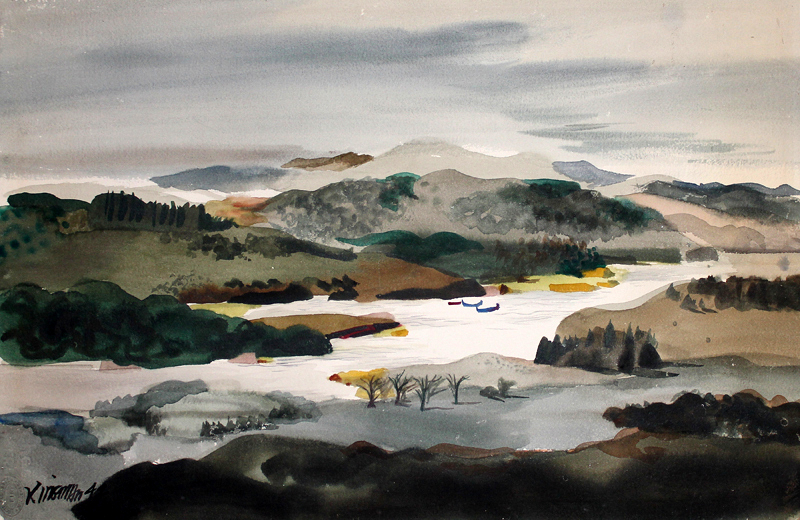
River Valley
annexgalleries.com

Treasure Island #3
sfmoma.org

Sutro Park
sfmoma.org

Flower Drum Song movie poster
theworld.org

Fishnet tile by Dong Kingman for Pomona Tile Manufacturing Company
flickr.com - The Atomic Kid 1959
Follow on Bloglovin

Thursday, June 20, 2013

Tile transformation

I don't usually write about my DIY projects. I've spent most of my life painting, drawing and making things...but this isn't a DIY blog, and I usually leave posts of that nature to others. However, I occasionally toss together something simple with a tie-in to modernism that I think might be of interest to a few readers.

Back in 2011, I read a fascinating post on the Planner, Perimeter, Predictor, Paul McCobb blog about the Distinguished Designer series of tiles by Pomona Tile Manufacturing Company, which included tiles by designers George Nelson, Paul McCobb, Saul Bass, Paul Laszlo, Millard Sheets, Dorothy Liebes and Dong Kingman. These tiles were sold from 1957 through 1963.

I immediately hurried to eBay to see if I could find any for myself and was able to score these two Starspray tiles by Paul McCobb, which then sat in a drawer in my kitchen for two years, waiting for me to do something with them.


Pomona Starspray tiles by Paul McCobb


When my new apartment was finished, I had two small sections of 1" mosaic tile left over from my bathroom, and I hated to throw them away, so I stuck them in a closet, where they've sat for the past two months.


Leftover mosaic tile from my apartment construction


The other day, I decided it was time to put these odds and ends of tile to good use, so I turned them into trivets and refrigerator magnets. Sure, I know...not very exciting. But very much like paper towels, they're something most of us use, even though we generally hide them when we're taking photos of our homes.

I had some self-adhesive round felt pads already. All I needed to buy were some 1/2" neodymium rare earth magnets and some E6000 industrial strength adhesive.


Waxman heavy duty felt pads
amazon.com

Rare earth super magnets
amazon.com

E6000 adhesive
amazon.com


After a few dabs of glue and a few hours' drying time*, I had a great pair of mid-century trivets and a set of simple kitchen magnets that look right at home in a modern kitchen.


DIY trivets
I may eventually have wood frames made for them, but they work nicely for now.

DIY slate kitchen magnets
(The large handmade ceramic magnet depicts the Acme Oyster House in New Orleans.
It is part of a set of three, also including Cafe du Monde and a shotgun house,
that I bought from an artist at the French Market many years ago.)


It was such a simple project that it needs no instructions, but I will warn you that there's a reason the rare earth magnets are called "super magnets." I bought the ones that are 1/2" in diameter and 1/16" thick, and even the ones that small are hard to get apart. The best method is to slide them apart, not pull. And keep a fair amount of distance between them on your table, because they will attract each other and jump all over your work surface if you let them. Their extra-strong magnetism is the reason you will want to use industrial strength adhesive too. Otherwise, when you try to pull them off your refrigerator, the decorative tile will pop right off, leaving a bare magnet on the door.

This was one of those "five minutes, tops" projects that I like so much, because I'm a sucker for instant gratification. Maybe it will give you some ideas for projects using leftover tile from your last remodel.

*After drying for less than 2 hours, the tile stayed on the magnet when I pulled it off metal. However, the product instructions recommend 24-72 hours' drying time for maximum adhesion.


Follow on Bloglovin