Flickr Widget

Showing posts with label Bauhaus. Show all posts

Sunday, November 20, 2011

Marianne Brandt

Marianne Liebe Brandt (1893-1983) studied painting and sculpture at the Weimar Hochschule für Bildende Kunst from 1911 until 1918. In 1919 she moved to Norway, where she married a Norwegian painter. After four years of living in Norway and France, the couple separated, and at the age of thirty-one, Marianne Brandt enrolled at the Bauhaus.

She was in the metalworking shop run by László Moholy-Nagy, who recognized her talent and encouraged her work. From 1924-1929 she produced several pieces that are now considered icons of Bauhaus design.

In 1926 she was made deputy head of the metalworking shop and was responsible for coordinating projects with industry. It was during this time that she designed a number of lamps and lighting fixtures for the firm of Körting & Mathiesen. While at the Bauhaus, she collaborated with Hin Bredendieck, Christian Dell, Hans Przyrembel, and Wilhelm Wagenfeld.

In 1929 Marianne Brandt worked briefly in the Berlin architecture practice of Walter Gropius. While there, she primarily designed modular furniture for mass production and worked on interior design for housing.

After leaving the Gropius firm, she was head of the design division for the applied arts at the Ruppelwerke Metalware Factory in Gotha until 1932.  For several years after leaving that position, she led a very retired life. Although brilliant at the Bauhaus, she was never able to establish herself with any success as an independent designer.


In 1949 she took a teaching position at the Hochschule der Bildenden Künste in Dresden, and from 1951 to 1954 she taught in East Berlin at the Institut für angewandte Kunst.

Later in her life, she returned to painting and sculpture. 

From marianne-brandt.com and designaddict.com 


Table lamp
jlohmanngallery.com

HMB25 pendant lamp
bonluxat.com

Teapot
tecnolumen.com

Ashtrays
unicahome.com

Kandem lamp
moma.org

Table clock
moma.org

Fixture HMB 25300
tecnolumen.com

Hot water jug
moma.org

Ceiling fixture
edition20.com

Tea infuser
dezeen.com

Thursday, January 6, 2011

Alvar Aalto

Alvar Aalto (1898-1976) was born in Finland and studied architecture at the Helsinki Technical College. By 1923 he had established a practice near his hometown. In 1924, he married his assistant Aino Marsio, also an architect. They remained creative partners until Aino´s death in 1949.

Aalto´s first major project was a tuberculosis sanatorium at Paimio, which was completed in 1933. Although he believed in the Bauhaus concept of of functionalism, he nevertheless preferred natural materials for this project for the sick. He had experimented with bending birchwood during the late 1920´s and had the technical capacity to create the famous Paimo armchair for this project. This chair was made from a single piece of molded plywood, the first of its kind.

Aalvar achieved international recognition at the 1939 New York World´s Fair with his Finnish Pavilion, dubbed a "symphony in wood." As a result of the publicity generated by the pavilion, he received a professorship in architecture at the Massachusetts Institute of Technology from 1940-1949. Aalto designed a dormitory there during his tenure. Other significant projects include the Viipuri Library, his own house in Helsinki, and an exhibition pavilion celebrating the 700th anniversary of the town of Turku.

Aalto was widely honored for his work. He received an honorary doctorate from Princeton University in 1947, and the Royal Gold Medal of Architecture from the British Government. He was also appointed to the Academie der kunste, Berlin, the academy of Finland, and was made a Royal Honorary Designer for Industry in England.

From lostcityarts.com

Paimio lounge chairs, designed 1930/these chairs 1960
1stdibs.com

Two-tier side table, 1930s
1stdibs.com

Upholstered dining chairs, 1950s
1stdibs.com

Birch bench, 1960s
1stdibs.com

Tank lounge chairs, 1950s
1stdibs.com

Executive desk, 1930s
1stdibs.com

Tea trolley, 1936
1stdibs.com

Vase, 1936
coodet.com

Friday, November 5, 2010

Lilly Reich

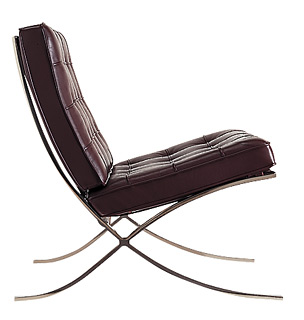
An icon of modern classic design and an international symbol of good taste, the Barcelona chair is one of the classiest chairs you can own. It is so much a part of the modern interior landscape that we might be forgiven feeling a certain familial loyalty to it and to its designer, Mies Van Der Rohe. Yet the Barcelona Chair was not designed by Mies alone. Multiple records state conclusively that this honor should be shared by his co-designer, a female architect and designer by the name of Lilly Reich (1885–1947). Many people maintain that Mies never intended to take all the credit for the Barcelona chair. He never denied her contribution, but his quiet nature did not make him a vocal supporter either.

Confined to traditionally acceptable female careers, Lilly Reich began her working life as a designer of textiles and women's apparel, but in 1912 she joined the Deutsch Werkbund, an organization often credited with sowing the first seeds of modern design and the precursor to the Bauhaus School. She worked in the studio of the famous Bauhaus designer Josef Hoffman, and by 1915 she had developed a professional reputation sufficient to be given increasing levels of responsibility at the Werkbund. In 1920 she became the first female to be made director of the Deutsch Werkbund.

It was also through the Werkbund that Reich met Mies and became his personal and professional partner. In the twelve years leading up to 1938, when Mies emigrated to the US, they were inseparable. Even after Mies left Germany, Lilly Reich continued to manage his personal and business affairs until her own death. She was at least as skilled a designer as Mies and was probably more articulate than he. Those who knew them regard her as the detail and execution person and Mies the broad conceptualist.

In 1939 Lilly visited Mies in the US but unfortunately did not stay. Shortly after her return to Germany, war broke out. In 1943 her studio was bombed. Luckily, when the bombing started she had moved 4000 drawings, including 900 of her own and 3100 of Mies’, to a farmhouse outside of Berlin to protect them.

Reich was drafted into a forced labor organization from 1943 to 1945. After her release and before her untimely death in 1947, she was instrumental in reviving the Werkbund, although it did not receive full legal status until three years after her death.

In addition to the Barcelona chair (also known as the Pavilion chair), Reich most likely deserves co-designer honors for the Brno chair, as well as several pieces of furniture in the famed Tugendhat House.

From barcelonachair.com


Bookcase, Tugendhat House
tugendhat.eu


Cabinet, Tugendhat House
tugendhat.eu

Thursday, September 16, 2010

Pioneers and prophets of modern design

While most people think "modern" means 1950 to the mid-1960s, the movement actually started two decades earlier.  Bauhaus visionaries like Marcel Breuer and Mies Van Der Rohe, as well as French designers Charles Edouard Jeanneret (Le Corbusier) and Charlotte Perriand were designing chairs in the 1920s that both predicted and influenced the departure from the stuffy conservatism of Victoriana.

In the 1930s Gilbert Rohde created tubular steel chairs for Herman Miller and Troy, and Alvar Aalto began to work with molded plywood. The 1938 sling chair designed by Jorge Ferrari-Hardoy became the classic Fifties "butterfly" design.  The rounded corners of Russel Wright's furniture for Conant Ball and his belief in mass-produced home decor changed the way furniture was made available to consumers.

The trio of chairs designed in 1940 by Charles Eames and Eero Saarinen won the MoMA Organic Design in Home Furnishings competition and reshaped our attitudes about the form and function of furniture.

After World War II, these chairs formed the vanguard of the mid-century modern movement and have been refined and repeated, copied and counterfeited, and faithfully revered ever since.


Wassily chair by Marcel Breuer, 1925
alginretro.com

Barcelona chair by Mies Van Der Rohe, 1927
knoll.com

Basculant "pony" chair by LeCorbusier and Charlotte Perriand, 1928
sillabarcelona.com

Molded plywood chair by Alvar Aalto, 1934
metmuseum.com
Tubular steel chair for Troy by Gilbert Rohde, 1930s
1stDibs.com

Russel Wright for Conant Ball
icollector.com

Lounge chair by Charles Eames and Eero Saarinen, 1940
moma.org