Flickr Widget

Showing posts with label Eliel Saarinen. Show all posts

Monday, July 1, 2013

Johnson Furniture Company

Johnson Furniture Company was founded in 1908 by three brothers...Carl, Hjalmar and Axel Johnson...who had immigrated to the United States from Sweden.  Before coming here, Carl had received a medal for his cabinetmaking skills from the king of Sweden. Tom Handley, who got his start at the prestigious London company of Waring and Gillow, became their in-house designer in 1908 and joined them as an officer in 1922. Handley established the company as a major producer of high-quality period revival residential furniture.

Upon Handley's death in 1926, David Robertson Smith took over as designer. Smith had worked for the famous Stickley Brothers Furniture Company, producing Arts and Crafts lines. In 1928 he led Johnson Furniture Company into the production of Art Deco and modern pieces. The company would later claim that they produced the first complete line of modern furniture in the United States.

Lorenzo (Renzo) Rutili was made head designer in 1933 and served in that capacity into the 1960s. He personally designed groups of modern furniture for the company, and he oversaw the contracted design of such famous modernists as Paul Frankl, Eliel Saarinen, Eva Lisa (Pipsan) Saarinen Swanson and J. Robert F. Swanson.
Under Rutili,, Johnson introduced a modular system for the home known as Flexible Home Arrangement (FHA), which was designed in 1939 by Saarinen and the two Swansons of the Cranbrook Institute. In the early 1950s Johnson produced several lines by Paul Frankl, such as the Contemporary line, made from pearwood with bleached cork countertops aand chairs with "plunging necklines," cutout backs that resembled the women's fashions of the day. Also in the 1950s, lines such as Country Directoire, Mediterranean and Riviera were designed by John Wisner.

In 1963 the last member of the Johnson family retired and sold the company to a group of investors under the leadership of James Van Oosten. Johnson Furniture was owned by Holiday Inns, Inc., between 1968 and 1975 and then returned to the ownership of Van Oosten. In 1983 the company merged with Rose Manufacturing Company to become RoseJohnson, Inc.

The company used a logo consisting of three teardrops spiraling around a common center, a sort of three-part yin and yang. This symbol commonly appears as a metal tag inside the right-hand drawer of case pieces, or on a paper label affixed to the back of a case piece or under the seat of a chair. Some paper labels between 1908 and circa 1930 also include a box with the printed signature “T.S. Handley”. In the 1960s the company name was printed in uppercase serif letters, with a crown resting on the “J”. During the late 1960s and early 1970s the trademark was a bold “J” over a small red dot.

From historygrandrapids.org


Cork and mahogany table with Plunging Neckline chairs by Paul Frankl
1stdibs.com

Paul Frankl lacquered cork coffee table
liveauctioneers.com

Chest by Eliel Saarinen and Pipsan Saarinen Swanson
treadwaygallery.com

White enamel chest by Eliel Saarinen and Pipsan Saarinen Swanson
1stdibs.com

Eliel Saarinen desk
pinterest.com

Renzo Rutili dining table
1stdibs.com

Renzo Rutili cabinet
1stdibs.com

Renzo Rutili cabinet
1stdibs

Johnson Furniture Company marks
historygrandrapids.org

Monday, October 3, 2011

Eero Saarinen

Eero Saarinen (1910-1961) was born in Finland and immigrated to the United States with his family in 1923. He was the son of internationally famous architect Eliel Saarinen. His mother was a textile designer and sculptor, and his sister was a designer and interior decorator.

Eliel Saarinen designed the Cranbrook campus outside Detroit, Michigan, but the entire family worked on the project. Cranbrook would remain a major influence on Eero's career, serving as a model of artistic collaboration and the concept of "total environment," which encompassed landscape, buildings, furnishings and decorative objects.

During the 1930s and 1940s Saarinen helped bring modern design to the mainstream of America. He collaborated with his father and with partners such as Charles Eames and Ralph Rapson, creating winning designs for furniture and architecture.

In 1937 he designed the Combined Living-Dining Room-Study project for Architectural Forum an during World War II, he worked on projects to develop housing prototypes for returning veterans and their families. Two of his best known residential designs are the Case Study House #9 with Charles Eames, better known as the Entenza House, and the Miller House, designed in 1957, which is a brilliant example of Saarinen's "total environment."

Saarinen's commercial works include the General Motors Technical Center, the United States Jefferson National Expansion Memorial, better known as the Gateway Arch, New York's Trans World Airlines Terminal and the Dulles International Airport Terminal outside Washington, D.C. Saarinen pioneered the use of self-rusting Cor-ten steel and designed the first mirror glass curtain wall, as well as the concept of the corporate campus.

Saarinen designed furniture throughout his entire career, exploring new materials, innovative construction techniques and sculptural forms. In 1940 he and Charles Eames won first prizes in the Museum of Modern Art's Organic Design in Home Furnishings competition, laying the foundation for his later designs for Knoll Associates. His Womb chair and Pedestal series of chairs and tables have become icons of mid-century design.

From eerosaarinen.net


Case Study House #9 - Entenza House
dailyicon.com

Miller House
archdaily.com

Tulip table from Pedestal series
classicdesigns.it

Tulip chairs from Pedestal series
knoll.com

Womb chair
brooklynmuseum.org

Grasshopper chair and ottoman
1stdibs.com

Dulles International
greatbuildings.com

Gateway Arch, St. Louis
artcyclopedia.com

Monday, June 6, 2011

Shu, Cranbrook and the roots of Knoll Associates

youtube.com
Uploaded by knolldesign, October 8, 2009

When Florence Schust (called "Shu" by her friends, as you will hear Richard Schultz refer to her in the video) saw Cranbrook Academy of Art, she knew it was the place she wanted to go to school. The campus, known as the birthplace of American modernism, was designed in 1928 by Eliel Saarinen and is comprised of ten Artist-in-Residence homes on one side of Academy Way and dormitories above graduate studios on the other side. The Academy's website provides several beautiful video tours of the campus today.

While a teenager and a student at the Kingswood School, a part of the 315-acre Cranbrook Educational Community, she met Eliel Saarinen and became an "unofficially adopted" member of the Saarinen family. During her years at Cranbrook Academy, she was immersed in a community of painters, sculptors, architects and designers, all working together to form an integrated concept. Later, when she married Hans Knoll, she brought Eero Saarinen, Ralph Rapson and Harry Bertoia...all from Cranbrook...into the company.

The magical beauty of Cranbrook, as well as the associations and friendships she formed there, no doubt influenced Florence Knoll's aesthetics and her vision of excellence for the company.

Sunday, January 9, 2011

Harry Bertoia

Harry Bertoia (1915-1978) was born in Italy. In 1930, he traveled to Detroit to visit his brother. Instead of returning home as he had planned, he remained in Michigan and enrolled in a technical high school for artistically gifted students. Eventually, he earned a scholarship to the Cranbrook Academy to study drawing and painting. After two years at Cranbrook, Bertoia was asked to direct the metal craft department and reorganize the metal shop, soon making metalcraft a popular program. Upon graduating in 1939, Eliel Saarinen, then director of the academy, invited Bertoia to join the faculty. Bertoia remained at Cranbrook until 1943.

Bertoia then moved to California to work with Charles and Ray Eames at the Evans Products Company, where Charles Eames worked as Director of Research and Development. There, they experimented with molded plywood technology in the service of the war effort. After Eames began to implement Bertoia's innovations without crediting him, Bertoia left.

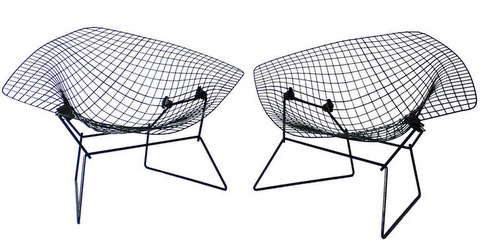
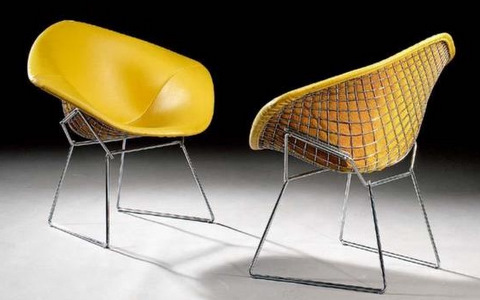
In 1950, Bertoia received an invitation from Hans and Florence Knoll to work as a designer for their well-known firm. Bertoia and his family relocated to Pennsylvania. By 1952, Bertoia had designed the famous "Diamond" seating collection, which included a lounge chair, stool, side chair, and a small chair for children. Constructed of industrial metal wire, the chair is remarkably strong despite its delicate appearance. Prized equally as a work of sculpture, it is still in production today and remains an icon of 20th century design.

Until his death in 1978, Bertoia was mainly active as a sculptor. Many of his sculptures are designed to move in the wind, some even to create sounds. He completed over 50 public sculptures in his lifetime, most notably for the chapel at the Massachusetts Institute of Technology and Dulles International Airport in Washington, DC. He was awarded the 1955 Fine Arts Medal, the 1956 AIA Craftsmanship Award, the 1968 Critics Award, and the 1973 AIA Gold Medal.

From lostcityarts.com and jonathanboos.com


Large diamond lounge chairs
1stdibs.com

Upholstered diamond chairs
authenticite.fr


Slat bench
1stdibs.com

Bar stools
1stdibs.com
Dining chairs
1stdibs.com

Dandelion sculpture
1stdibs.com