Flickr Widget

Showing posts with label Gilbert Rohde. Show all posts

Monday, August 1, 2011

Pssst...They're called plinths.

A plinth is a type of furniture base that sits directly on the floor, rather than having legs. I'd be willing to bet that if you stopped 50 people on the street, most of them would say that mid-century furniture has tapered legs, but a number of MCM designs incorporated plinth bases.


Edward Wormley side table
griffintrading.com

Gilbert Rohde Paldao table, with one leg and one plinth base
treadwaygallery.com

Harvey Probber night stand
1stdibs.com

Milo Baughman night stands
metroretro.com

Renzo Rutili credenza
metroretro.com

T. H. Robsjohn-Gibbings double plinth base table
1stdibs.com

Peter Hvidt chest
lookmodern.com

Paul Lazlo cabinet
1stdibs.com

Paul Evans credenza
galere.net

Paul Evans sofa
galere.net

Milo Baughman chairs
1stdibs.com

Vladimir Kagan Serpentine sofa
edition20.com


This is a contemporary sofa designed by Vladimir Kagan in 1999, but I just had to include it in this post.  The piece may not fall into the mid-century time frame, but Kagan opened his first shop in 1949 and has been designing gorgeous furniture for decades. Since this sofa appears to be a variation on his 1950 Serpentine sofa, it definitely deserves a look, in my opinion.


Bilbao sofa by Vladimir Kagan
1contemporary.com

Thursday, April 21, 2011

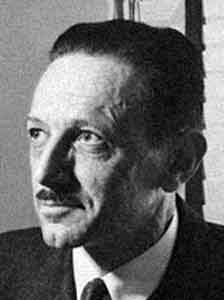
Gilbert Rohde

Gilbert Rohde
Gilbert Rohde (1894-1944) was the son of a New York cabinetmaker who became one of the most influential furniture designers of his time. Though not a household name today, he is the designer behind many of the names that we do know today.

In 1923 Rohde turned one of his first job experiences as a political cartoonist into a job illustrating furniture for the Abraham and Strauss department store. He soon turned that talent into furniture design, selling his early work to Lord and Taylor. His style at that time combined the simplicity and rationalism of Bauhaus design with the sense of form and ornamentation of Art Deco, working mainly in Bakelite and chrome.

In 1930 Heywood-Wakefield began using his designs. He had great success with a bentwood chair he designed for the company. In that year, he attracted the attention of Herman Miller, which at that time was on the brink of bankruptcy, because their traditional pieces and historical reproductions were no longer selling. He convinced them that modernism was the way they needed to go, so in a desperate effort to stay in business, they showed his designs for bedroom furniture at the 1933 Chicago World's Fair. With their updated image, they stopped producing traditional pieces and began to have Rohde design entire sets of living and dining room furniture. He acted as a design consultant for the company from 1932-1944.

During that time, he designed chrome furniture for the Troy Sunshade Company and also worked for Thonet. His work was exhibited at the MoMA in 1934 and at the New York World's Fair in 1939. He was director of the Design Laboratory in New York from 1935-1938 and was head of the Industrial Design department at  the NYU School of Architecture from 1939-1943.

From r20thcentury.com

Heywood Wakefield bentwood chairs
1stdibs.com
Sofa table for Troy Sunshade Company
1stdibs.com
Lounge chair and ottoman for Herman Miller
thisnext.com
Kidney-shaped desk for Herman Miller
1stdibs.com
Lounge chair for Troy Sunshade Company
1stdibs.com
Paldao table for Herman Miller
treadwaygallery.com
Three-seater sofa for Troy Sunshade Company
1stdibs.com
Desk lamp for Mutual-Sunset Lamp Company
treadwaygallery.com
Paldao end tables
1stdibs.com
Coffee table for Troy Sunshade Company
treadwaygallery.com
Sofa bed for Herman Miller
1stdibs.com

Thursday, September 16, 2010

Pioneers and prophets of modern design

While most people think "modern" means 1950 to the mid-1960s, the movement actually started two decades earlier.  Bauhaus visionaries like Marcel Breuer and Mies Van Der Rohe, as well as French designers Charles Edouard Jeanneret (Le Corbusier) and Charlotte Perriand were designing chairs in the 1920s that both predicted and influenced the departure from the stuffy conservatism of Victoriana.

In the 1930s Gilbert Rohde created tubular steel chairs for Herman Miller and Troy, and Alvar Aalto began to work with molded plywood. The 1938 sling chair designed by Jorge Ferrari-Hardoy became the classic Fifties "butterfly" design.  The rounded corners of Russel Wright's furniture for Conant Ball and his belief in mass-produced home decor changed the way furniture was made available to consumers.

The trio of chairs designed in 1940 by Charles Eames and Eero Saarinen won the MoMA Organic Design in Home Furnishings competition and reshaped our attitudes about the form and function of furniture.

After World War II, these chairs formed the vanguard of the mid-century modern movement and have been refined and repeated, copied and counterfeited, and faithfully revered ever since.


Wassily chair by Marcel Breuer, 1925
alginretro.com

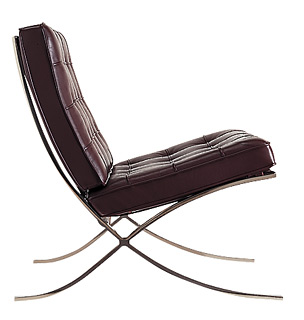
Barcelona chair by Mies Van Der Rohe, 1927
knoll.com

Basculant "pony" chair by LeCorbusier and Charlotte Perriand, 1928
sillabarcelona.com

Molded plywood chair by Alvar Aalto, 1934
metmuseum.com
Tubular steel chair for Troy by Gilbert Rohde, 1930s
1stDibs.com

Russel Wright for Conant Ball
icollector.com

Lounge chair by Charles Eames and Eero Saarinen, 1940
moma.org