Flickr Widget

Showing posts with label fiberglass. Show all posts

Thursday, March 3, 2011

According to an Heir: Is it real?

This is the third and final post about the Jet Set Modern article entitled "Is It Real?" The third segment of that article is from the point of view of an heir of a famous designer...Eames Demetrios of the Eames Office, who is the grandson of Charles and Ray Eames.  (First post: According to a Collector; second post: According to a Manufacturer)

Demetrios points out that most designers want to see their designs made in the way they intended, which is why they choose a family member, a company or a foundation to protect their trademark and name-and-likeness rights after they're gone. He talks about the "legitimate protection of designers and their successors" but sidesteps the subject of design patents specifically. From an analogy he uses, it's clear he knows that manufacturers of reproductions are not breaking any law, as long as they don't use a protected trademark or a likeness of a famous person, but he nevertheless questions their ethics.

He agrees that one of the core values of the modern design movement was affordability, but he points out that quality was a core value as well. He calls making an inferior product and passing it off as an original "a form of looting." While I wholeheartedly agree with what he's saying about passing off a shoddy product as genuine, I couldn't help but notice that he avoids addressing the manufacturer who is making an extremely high quality reproduction and selling it at an affordable price. I get the impression that would not receive his approval either. Reading between the lines, I get the sense that he'd be happier if American patent laws granted family members or their assigns exclusive rights in perpetuity. Frankly, I'm sure I'd feel the same way if I were the descendant of a famous designer.

In fairness to Demetrios, I got overall impressions from the previous two articles. I took from McLendon's article that the primary motivation of most collectors is the desire to have the "bragging rights" that come with owning an original, more than to protect the designer's legacy or even to protect their own investment. (We bloggers point with pride to our "real" pieces all the time, even if we don't have a significant amount of money invested in them.) Berg's point seemed to be that what he's doing is legal, so buy his product if you like it...and if you don't, stop complaining.

Ultimately, there may be no clear right or wrong in this debate. It all comes down to individual preferences and needs, and that's probably why patent and trademark laws were written as they were...to allow American consumers freedom to choose what they buy, with the caveat that you generally get what you pay for.


Original Eames fiberglass rocker ($1,200)
1stdibs.com

Herman Miller molded plastic chair ($349)
dwr.com

Case Study fiberglass shell chair by Modernica ($435)
modernica.com


(It is probably pertinent to point out here that Demetrios wrote a letter to Dwell magazine in 2008, condemning them for running Modernica ads and criticizing Modernica for continuing to produce fiberglass chairs after the Eames Office, Herman Miller and Vitra decided to cease production of fiberglass chairs and make molded plastic chairs instead. That's a another debate of its own.)


Molded plastic chair from Inmod ($328)
inmod.com

Wednesday, January 26, 2011

Fiberglass shades

Most of us mid-century lovers seem to have an affinity for lamps, and nothing seems to turn that feeling into a full-fledged love affair like a great fiberglass shade.

During the late 1940s and early 50s, fiberglass was being molded into furniture and pressed paper thin for lampshades. It was generally wrapped around metal frames and held in place with lacing. The fiberglass was most often left white, but it was not unusual to see it in tan, off-white, pink, turquoise and pale green. The surface was often decorated with popular motifs such as leaves, atomic shapes, stars and abstract designs, usually in gold or black.

In the 1950s science was influenceing every facet of life. Household objects began to take on space age characteristics. Thickly molded fiberglass, similar to that used in furniture, was molded into cones and used as shades. Flat shades covered some, echoing the shape of a flying saucer. Metal arms held the shades at odd angles. The fiberglass could be pressed flat or left "furry" for texture.

During the 1960s plastic shades began to replace fiberglass, which was more widely used for insulation. Many of the old shades are still with us, however, because fiberglass does not break down or wear out easily.

From coololdstuff.com

1stopretroshop.com

astronomy-pictures.net

metroretrofurniture.com

musclecars.net

nvisionshop.com

retrotablelamps.com

musclecars.net

1stopretroshop.com

antiquehelper.com
This lamp appears to have a fabric shade
 with a fiberglass cone uplight around the bulb.

Tuesday, September 28, 2010

Joe Colombo

Joe Colombo (1930-1971) was an Italian painter, sculptor and designer. Colombo studied art, but in the 1950s he assumed control of the family electrical equipment company, and he used the factory to experiment with design.

He opened his own design company in the early 1960s, and for the next decade he produced a large body of innovative work.  He theorized that technology would transform domestic life, and he sought to achieve these new environments with new materials, such as fiberglass, PVC and polyethylene. His Impronta armchair (1961), Acrilica lamp (1962), Roli chair (1962) and Universale chair (1965) were made with these materials.

His Boby taboret (1970) has remained so popular that it is still in production today, selling for over $300.  My daughter and son-in-law, who are the luckiest estate sale shoppers in the world, have found two vintage models, one they paid $1 for and another they got for $5.

From lostcityarts.com


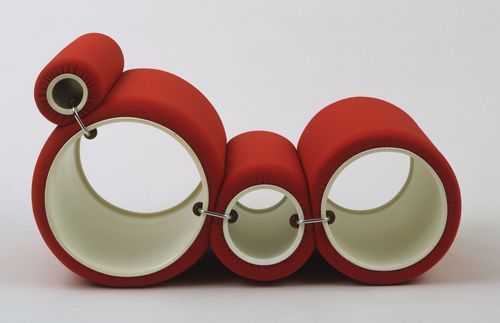
Tube chair - PVC, foam and fabric, 1955
moma.org

Acrilica lamp, 1962
moma.org

Molded plywood armchair, 1964
moma.org

Boby taboret art cart, 1970
moma.org