Flickr Widget

Showing posts with label Jack Lenor Larsen. Show all posts

Saturday, November 2, 2013

Taking a shine to Paul Evans

Several pieces of the polished chrome and brass Cityscape series that Paul Evans designed for Directional...a coffee table, a console table and a bench...are the latest additions to the store, in all their shiny glory. The bench still has its original lavish velvet upholstery by famed textile designer Jack Lenor Larsen. It doesn't get much more glamorous than this!


Paul Evans Cityscape coffee table for Directional

Cityscape coffee table signature

Cityscape console table

Cityscape console table signature

Cityscape bench

Monday, January 30, 2012

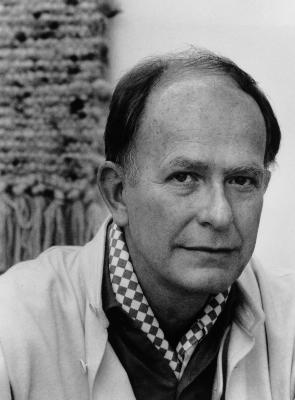
Jack Lenor Larsen

Jack Lenor Larsen (1927- ) was born in Seattle, Washington, to Norsk-Canadian parents. He studied architecture at the University of Washington, but in 1945 he took a weaving class, which changed the course of his life.

He worked for a time at Handcraft House in California, teaching weaving to famous students like Joan Crawford, until he was offered a position as teaching assistant at Cranbrook Academy, from which he received a Masters of Fine Arts in 1951.

In 1952 Larsen move to New York, and by 1953 he had formed Jack Lenor Larson, Inc. Florence Knoll, who had rejected his portfolio in 1951, asked him to do a group of furniture fabrics in olive green and shades of orange, which became the avocado green and harvest gold of the 1960s.

In 1954 he opened a showroom on Park Avenue and sold to customers like Marilyn Monroe and Frank Lloyd Wright. In 1958 he designed upholstery fabrics for Pan Am. By 1974 his various companies were producing fabric in 30 countries. He was also operating as Larsen Design Studio, Larsen Carpet and Leather, and Larsen Furniture.

While Larsen has designed many of the beautiful textiles sold by his companies, he has also employed many talented designers who have created many of the fabrics for Jack Lenor Larsen, Inc. and Larsen Design Studio.

His work is displayed at the Museum of Modern Art, the Metropolitan Museum of Art, the Philadelphia Museum of Art, the Art Institute of Chicago, the Cooper-Hewitt Museum and the Fashion Institute of Technology, among others. His art center, LongHouse Reserve, houses treasures from around the world.

From nytimes.com, artists.parrishart.org, craftinamerica.org


Horsecloth, 1952 (designed by Jack Lenor Larsen)artsmia.org

Eclipse, 1955 (designed by Warren Platner)
artsmia.org

Spice Garden, 1959 (designed by June Groff)
artsconnected.org

Spice Garden on Milo Baughman chair
1stdibs.com

Primavera, 1960 (designed by Don Wight)
elledecor.com

Primavera pillows
vandm.com

Aurora, 1961 (Larsen Design Studio)
artsmia.org

Aurora chairs
redmodernfurniture.com

Caravan, 1962 (designed by Anita Askild)
etsy.com - pixiedustlinens

Caravan on a Paul McCobb sofa for Directional
treadwaygallery.com

Caravan on an Edward Wormley ottoman for Dunbar
treadwaygallery.com

Milo Baughman sofa, 1960s
jasonarnoldformodern.com

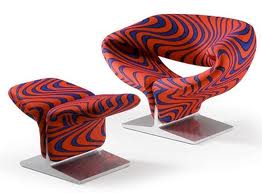
Momentum Blue Flame on Pierre Paulin Ribbon chairs, 1960s
anothermag.com

Sunday, September 25, 2011

John Nyquist

John Nyquist
John Nyquist (1936- ) is the son of first-generation Swedish-Americans. He was raised in South Dakota and moved to Long Beach, California, when his father returned from World War II. He studied art and industrial design at California State University. He taught at California State University Long Beach and then at Cerritos College.

Nyquist began his career in furniture design in 1959. He found early clients through architects, construction firms and private patrons who saw his work in the "California Design" shows, 13 influential exhibitions at the Pasadena Art Museum, now the Norton Simon.

Nyquist favors materials such as Brazilian rosewood and Makassar ebony. He uses richly colored wool fabric by Jack Lenor Larsen. He sometimes uses leather from Connolly, a British firm that did the interiors of Rolls-Royces and Jaguars.

Nyquist says he was influenced by Shaker and Scandinavian furniture, the sculpture of Henry Moore and the craftsmanship of Green & Greene's Gamble House. His furniture is characterized by the frequent use of contrasting woods, exposed joinery and the lack of varnish.

Like fellow Californian Sam Maloof, Nyquist became part of the "California Roundover Movement" that was pioneered by Charles and Henry Greene. These woodworkers sculpted the edge of a tabletop or the arm of a chair to soften hard right angles with curved and sloping lines.

From craftinamerica.com and latimes.com


Walnut and leather armchairs
reformgallery.1stdibs.com

Rosewood hutch
reformgallery.1stdibs.com

Magazine rack
balustradeandbitters.com

 Chaise à bascule
artnet.com
Armchairs
artnet.com