Flickr Widget

Showing posts with label Heywood-Wakefield. Show all posts

Monday, September 12, 2011

Mid-century living rooms

In the 1950s the term “living room” was expanded to include any room in which the American family visited, listened to music, watched TV or otherwise lived and played together.

The concept of a family room or den was growing in popularity then, sometimes replacing a formal living room altogether, while sometimes simply providing a place for children to play, since they usually weren’t allowed in a formal living room except on special occasions.

Initially, these multi-purpose rooms were rather modest, but by the end of the decade, they had grown in importance and in size.
There are more great living room photos to be found on the Mid-Century Home Style site, so check it out.

Text and images from midcenturyhomestyle.com

Armstrong in coral and green, 1950
Coral and gray living room, 1951
Modern bungalow, 1953
Armstrong cork floor, 1953
Stone fireplace, 1953
Sun porch, 1953
Modern Wormley, 1953
Heywood-Wakefield, 1954
Armstrong atomic, 1954
Clerestory windows, 1954
Armstrong Excelon flooring, 1957
Scandinavian, 1958

Thursday, April 21, 2011

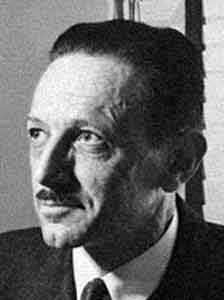
Gilbert Rohde

Gilbert Rohde
Gilbert Rohde (1894-1944) was the son of a New York cabinetmaker who became one of the most influential furniture designers of his time. Though not a household name today, he is the designer behind many of the names that we do know today.

In 1923 Rohde turned one of his first job experiences as a political cartoonist into a job illustrating furniture for the Abraham and Strauss department store. He soon turned that talent into furniture design, selling his early work to Lord and Taylor. His style at that time combined the simplicity and rationalism of Bauhaus design with the sense of form and ornamentation of Art Deco, working mainly in Bakelite and chrome.

In 1930 Heywood-Wakefield began using his designs. He had great success with a bentwood chair he designed for the company. In that year, he attracted the attention of Herman Miller, which at that time was on the brink of bankruptcy, because their traditional pieces and historical reproductions were no longer selling. He convinced them that modernism was the way they needed to go, so in a desperate effort to stay in business, they showed his designs for bedroom furniture at the 1933 Chicago World's Fair. With their updated image, they stopped producing traditional pieces and began to have Rohde design entire sets of living and dining room furniture. He acted as a design consultant for the company from 1932-1944.

During that time, he designed chrome furniture for the Troy Sunshade Company and also worked for Thonet. His work was exhibited at the MoMA in 1934 and at the New York World's Fair in 1939. He was director of the Design Laboratory in New York from 1935-1938 and was head of the Industrial Design department at  the NYU School of Architecture from 1939-1943.

From r20thcentury.com

Heywood Wakefield bentwood chairs
1stdibs.com
Sofa table for Troy Sunshade Company
1stdibs.com
Lounge chair and ottoman for Herman Miller
thisnext.com
Kidney-shaped desk for Herman Miller
1stdibs.com
Lounge chair for Troy Sunshade Company
1stdibs.com
Paldao table for Herman Miller
treadwaygallery.com
Three-seater sofa for Troy Sunshade Company
1stdibs.com
Desk lamp for Mutual-Sunset Lamp Company
treadwaygallery.com
Paldao end tables
1stdibs.com
Coffee table for Troy Sunshade Company
treadwaygallery.com
Sofa bed for Herman Miller
1stdibs.com

Sunday, November 14, 2010

Toshmahal

Hank Tosh's name is spoken in a tone approaching reverence by mid-century mavens in the Dallas-Fort Worth area.  He has been called The Furniture Savior, and not without reason, because he works restoration and refinishing miracles.  Toshmahal, his business in Dallas' Oak Cliff neighborhood, turns out some of the most breathtaking pieces in town.

Tosh will work on furniture from other periods, but he admits that MCM is his personal favorite and his specialty, since he began collecting long before he made his living working with wood.  He has an affinity for Danish Modern and Heywood Wakefield, and his mastery of the Heywood Wakefield wheat and champagne finishes has become nothing short of legendary.

Tosh started his career at Lakewood Furniture doing the "gruntwork" of sanding, stripping and a little staining. Eventually, he opened his own shop and now is the go-to guy of many of the major designers and mid-century dealers in the area.  He mixes his own toners and stains and claims that a great deal of trial and error went into perfecting them.

Calling some designers people who "like to do bad things to good furniture" in the name of making everything match and covering imperfections, he generally discourages "ebonizing" and encourages using many different types and colors of woods in the same house or even the same room.


When asked for one top secret trick of the trade, Tosh offers several, including steaming dents out of furniture with a wet paper towel and an iron and using heavy, uncut carnuba wax as a cleaning and waterproofing agent. He advises people not to try refinishing unless they know what they're doing, as it just makes his job more costly and more difficult, but his best tip for lovers of beautiful furniture is a simple one: Use a coaster!


From interviews on decordallas.com and dfwmcm.blogspot.com


Dunbar rosewood cabinets
toshmahal.com

Herman Miller thinedge cabinet
toshmahal.com

Robsjohn-Gibbings table
toshmahal.com

Heywood Wakefield hutch
toshmahal.com

Before
After

Before
After

Before
After

Before
After

Before
After