Flickr Widget

Showing posts with label Hille. Show all posts

Tuesday, December 27, 2011

You look so familiar: Part 3 - Stacking

Ah, the ubiquitous stacking chair. It seems that almost everyone has dabbled a bit in this design over the years, and the wheel is still being reinvented, so to speak, as evidenced by Knoll's 1999 Cirene by Vico Magistretti, the 2000 Gigi by Marco Maran and  2004 chair by Ross Lovegrove. 

A quick Google of "stacking chairs" will show just how many designers and manufacturers have come out with their versions, yet very few, if any, significant changes or improvements have been made over the last 6 1/2 decades. Enough already!


The Stacking Chair

Charles and Ray Eames - 1948
treadwaygallery.com

Ray Komai - 1949
1stdibs.com

Georg Leowald - 1955
architonic.com

Arne Jacobsen Chair 3107 - 1955
designmuseum.org

Robin Day for Hille - 1963
telegraph.co.uk

Cirene chair by Vico Magistretti - 1999
knoll.com

Gigi chair by Marco Maran - 2000
vastudc.com

Ross Lovegrove for Knoll - 2004
knoll.com

Wednesday, December 14, 2011

You look so familiar: Part 1 - Tall legs, wraparound arms

Ever notice how designers have freely "borrowed" design elements from each other over the decades? I'm not talking about fly-by-night manufacturers or hack designers who generally get our upturned noses. I'm talking about well-known designers with impeccable reputations whom most of us revere.

I decided to examine lookalike chairs, and what I found most interesting was how one designer borrowed a seat idea. Then another copied a back or a pedestal or an arm. Before long, one chair design morphed into the next, so that it was hard to draw clear lines between categories...and sometimes between designers.

For the next few weeks, I'll feature some of the distinct lookalikes, as well as the specific design elements that have shown up frequently over the years. It makes me wonder: How many ways are there to design a chair, really? Why do some people dismiss Burke tulip chairs as mere knockoffs while celebrating the designs of Robin Day (one of my favorites), such as the last chair below that bears just as strong a resemblance to Wegner's The Chair?  Is there anything new under the sun, when you get right down to it? And are we designer snobs?

Note: For a more in-depth look at the topic of actual knockoffs/reproductions from the point of view of a collector, from a manufacturer and from the heir of a designer, you can read a three-part post I did about the article "Is It Real?" from Jet Set Modern in February and March of this year.


Tall, Skinny Legs and Wraparound Arms

Hans Wegner The Chair - 1946
danish-furniture.com

Ib Kofod-Larsen - 1956
glo-1stdibs.com

Neils O. Moller - 1958
treadwaygallery.com

Robin Day for Hille - 1960s
twentiethcenturyretro.com

Monday, November 22, 2010

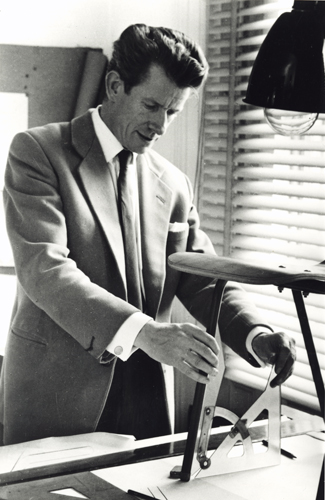
Robin Day (1915-2010)

Robin Day, British furniture designer and husband of textile designer Lucienne Day, died November 9 at age 95.

After World War II, Day turned his hand to exhibition and poster design. In 1948 he and Clive Latimer won first prize in the storage section of the International Competition for Low-Cost Furniture organized by MoMA. The cabinets in their flexible, multi-functional storage system were fabricated from a tube of molded plywood cut into sections--a radical innovation for the time.
Day's success brought him to the attention of a British manufacturer, Hille, which had specialized in period furniture, but was eager to modernize. Seizing this opportunity, he designed a series of simple, functional chairs, tables, desks and storage units that harnessed the latest wood and metalworking techniques. Many of his designs were low-cost, such as the beech-framed 1950 Hillestak chair with its molded plywood seat. Whereas pre-war furniture was solid and bulky, Day’s designs were pared down and seemed to float above the ground. “What one needs in today’s small rooms is to see over and under one’s furniture,” he told a journalist in 1955.

Day’s inventive response to technology reflected the positive, forward-looking mood of the early post-war era, with his sparing use of materials and economical approach to construction. From the outset Robin Day was a deeply moral and highly principled designer, who was not interested in making a design statement, but in solving practical problems in the most rigorous, efficient and cost-effective way. “A good design must fulfill its purpose well, be soundly constructed, and should express in its design this purpose and construction,” he stated in 1962.

The commission to design furniture for the Royal Festival Hall marked a turning point in Day’s career. The project included restaurant and foyer furniture, auditorium seating and orchestra chairs, each with specific functional demands. His talents were also evident in the two room settings he designed for the House and Gardens Pavilion at the Festival: one low-cost, one high-cost, both equipped with his latest storage furniture and chairs.

Robin Day married Lucienne Conradi in 1942. It was their passion for design that drew the couple together and formed the basis of their personal and professional relationship. Acting as mutual catalysts, they spurred each other on to realize their ambitions and to produce their most original work.  Lucienne Day died in January of this year at age 93.

From designmuseum.org

Polypropylene stack chair, 1963
designmuseum.org

Hillestak chair, 1950
designmuseum.org

Royal Festival Hall lounge chair, 1951
twentyfirstcenturyretro.com

Robin and Lucienne Day's living room
designmuseum.org


arts.brighton.ac.uk