 |
| Some of my daughter's favorite things |

Showing posts with label L. E. Smith. Show all posts
Showing posts with label L. E. Smith. Show all posts
Saturday, September 24, 2016
Spaces: Living room built-in
The built-ins in the formal living room hold my daughter's treasures. She started collecting swung vases from estate sales 20 years ago, and I usually give her one or two every Christmas. She also loves Blenko owls and other glass figurals.


Tuesday, August 2, 2011
Horse bookends...more complicated than I knew
A reader suggested that the horse bookends in a previous post might have been manufactured by A. H. Heisy & Company, rather than L. E. Smith Glass Company. The possibility intrigued me, so I started to look for information. I located an attribution to Heisy in a Live Auctioneers listing, but most of the information I found centered around three almost identical designs by L. E. Smith, Fostoria and New Martinsville. Heisy wasn't mentioned in those discussions.
The abbreviated version of what I read is that the main differences are in the mane and the base, as detailed here:
L. E. Smith horses are easily identified by a knotted mane and a much thicker base than the other two. Also, the neck is thinner and not as arched. The glass quality is somewhat inferior to that of Fostoria or New Martinsville, and they are slightly less valuable.
Fostoria horses have a cropped mane which appears very slightly beaded, a Roman nose and a 1/2" wide ledge around the base. Also, the right ear is smaller than the left ear.
New Martinsville horses have a cropped mane which appears straight/squared off, a Roman nose and a 1" wide ledge around the base.


After looking at a number of sites and reading several discussions about how to tell the three apart, I was confident my bookends were produced by Smith, but to be absolutely sure, I sent a photo to the company, which is still in business, and received a confirmation from L. E. Smith employee Patti Bryner that mine were indeed made by their factory. I readily admit, however, that my identification was pure luck. Although I'm sure I've seen photographs of all three types, I had never noticed the differences and had no idea the Fostoria or New Martinsville bookends even existed. I've been calling them all L. E. Smith for years.
I also sent an email to the curator of the Heisy Glass Museum to find out if that company produced similar rearing horse bookends, but I have not received a response yet. If I find out that they did, I will update again.
Thanks to reader Mitzy for her comment, which resulted in my finding out more than I ever thought possible about these bookends that my parents received as a gift when they were a young married couple (including the fact that they are less valuable than the others, which is too bad for me). I hope what I gleaned from my research provides some helpful information to you vintage glass shoppers/sellers.
Update 8/2/2011: I just received another email from L. E. Smith employee Patti Bryner with more information about the bookends. She said:
The abbreviated version of what I read is that the main differences are in the mane and the base, as detailed here:
L. E. Smith horses are easily identified by a knotted mane and a much thicker base than the other two. Also, the neck is thinner and not as arched. The glass quality is somewhat inferior to that of Fostoria or New Martinsville, and they are slightly less valuable.
Fostoria horses have a cropped mane which appears very slightly beaded, a Roman nose and a 1/2" wide ledge around the base. Also, the right ear is smaller than the left ear.
New Martinsville horses have a cropped mane which appears straight/squared off, a Roman nose and a 1" wide ledge around the base.

L. E. Smith
etsy.com

Fostoria
Forum - ebay.com

New Martinsville
Forum - ebay.com
I also sent an email to the curator of the Heisy Glass Museum to find out if that company produced similar rearing horse bookends, but I have not received a response yet. If I find out that they did, I will update again.
Thanks to reader Mitzy for her comment, which resulted in my finding out more than I ever thought possible about these bookends that my parents received as a gift when they were a young married couple (including the fact that they are less valuable than the others, which is too bad for me). I hope what I gleaned from my research provides some helpful information to you vintage glass shoppers/sellers.
Update 8/2/2011: I just received another email from L. E. Smith employee Patti Bryner with more information about the bookends. She said:
You are correct about the base. I don't know if Heisy made them or not. They were produced [by L. E. Smith] from May of 1945 until the early part of 2000. This book end has been attributed to the American Glass Company in the past; however, the drawing in Plate 841 [of LE Smith: The First One Hundred Years] is from an application submitted by LE Smith for wage arbitration by the National Association of Manufacturers of Pressed and Blown Glassware...Hope this helps you out. If you can, buy the book LE Smith: The First One Hundred Years. It has a lot of information about our products.
Wednesday, April 27, 2011
In the store: Glass, glass and more glass
I'm a glass lover, so lately I've been in glass heaven. A buying trip turned up several great pieces, and then last weekend we had the opportunity to buy even more from a local couple that collects Blenko in a big way. How big, you ask? How about 1700 pieces collected over the last 7 years? That kind of big way.
Not only did we get some great pieces from them, but we got to pick their brains about Blenko. They've visited the factory, and they were lucky enough to meet Wayne Husted, the late Winslow Anderson and the late William H.Blenko, Jr.
In addition to Blenko, we got some Pilgrim and L. E. Smith that are also pretty, as well as some pieces we are still researching. Enjoy the color and sparkle of our new pieces.
Not only did we get some great pieces from them, but we got to pick their brains about Blenko. They've visited the factory, and they were lucky enough to meet Wayne Husted, the late Winslow Anderson and the late William H.Blenko, Jr.
In addition to Blenko, we got some Pilgrim and L. E. Smith that are also pretty, as well as some pieces we are still researching. Enjoy the color and sparkle of our new pieces.
 |
| Blenko cornucopia |
 |
| Blenko dish |
 |
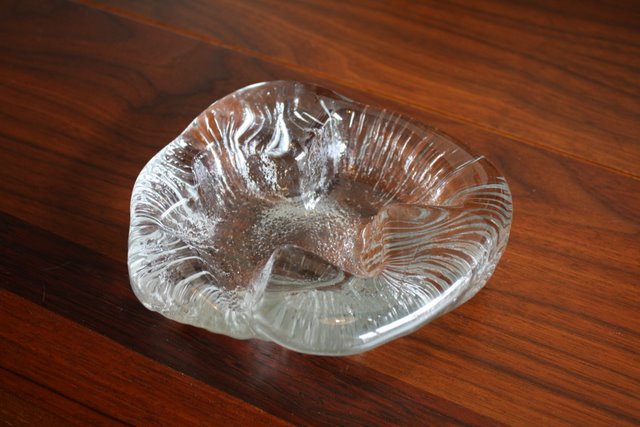
| L. E. Smith bowl |
 |
| Blenko owl |
 |
| Blenko head |
 |
| Pilgrim vase |
 |
| Blenko water bottle |
 |
| Blendo drink set |
 |
| Bowl, unidentified so far |
 |
| Candy dish, also unidentified yet |
Saturday, April 16, 2011
L. E. Smith Glass Company
A blog reader emailed me the other day for help identifying the maker of a large swung vase, which I thought to be made by L. E. Smith Glass Company. Most people are quick to think of Blenko and Fenton and Viking, but many forget or don't know about this company, which has a distinctive history and is still producing glass today.
L. E. Smith Glass Company has been in business since 1907 and is one of only a few remaining hand-made glass factories left in the United States.
The company manufactured the first headlight lens for the Model T Ford, as well as the original glass mixing bowl, and their vintage decorative items are valued by many collectors.
Like all the other glass companies of the time, L.E. Smith began producing colored glass in the mid 1920’s, making pink, green, amber, yellow, amethyst and cobalt pieces as early as 1926. In the late 1920’s, Smith Glass devised a formula for black glass that set it apart from other manufacturers of the time. This black glass, which shows amethyst when held up to a light, has proved to be the most collected in the industry.
In 2005, Smith Glass was purchased by William Kelman.
L. E. Smith Glass Company has been in business since 1907 and is one of only a few remaining hand-made glass factories left in the United States.
The company manufactured the first headlight lens for the Model T Ford, as well as the original glass mixing bowl, and their vintage decorative items are valued by many collectors.
Like all the other glass companies of the time, L.E. Smith began producing colored glass in the mid 1920’s, making pink, green, amber, yellow, amethyst and cobalt pieces as early as 1926. In the late 1920’s, Smith Glass devised a formula for black glass that set it apart from other manufacturers of the time. This black glass, which shows amethyst when held up to a light, has proved to be the most collected in the industry.
In 2005, Smith Glass was purchased by William Kelman.
From lesmithglass.com
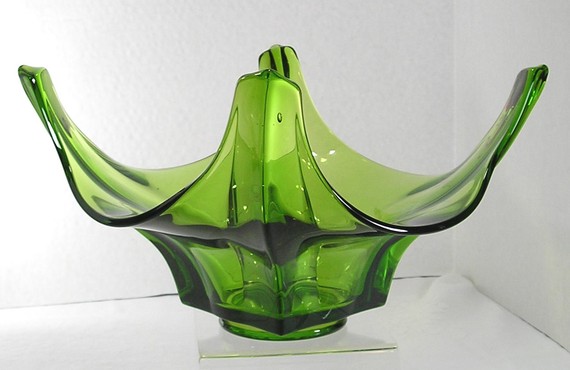 |
| Large centerpiece bowl blisstiques at etsy.com |
 |
| Architectural swung glass vase stylehive.com |
 |
| Opaque bittersweet table vase collectorsweekly.com |
 |
| Black amethyst vase centennialantiques.com |
 |
| Rearing horse bookends that belonged to my parents |
 |
| Center handle serving tray clicksnipwow.com |
 |
| Black amethyst rose bowl with clear frog cyberattic.com |
Saturday, January 22, 2011
The ubiquitous swung vase
Makers of mid-century glass, such as Viking Art Glass and L. E. Smith Glass Company, made swung vases, which were very popular. Other companies like Pilgrim, Fenton, Tiffin and Fostoria made their own versions of the swung vase, but they were not as common.
The vases generally ranged in height from a 7” bud vase to the giant “architectural” floor versions that were sometimes over 40” tall. They were hand-blown, then hand-swung to lengthen, and then the opening was hand-tooled and heat polished smooth. The vases were literally swung around to produce the neck, with stunning results.
Popular colors were amberina (an orange-red fading to yellow, also called persimmon), green, amber, red, blue and an opaque orange usually referred to as bittersweet. However, the vases can be found in other colors, such as peach, amethyst, pale yellow, pale aqua and even multi-colored art glass versions.
 |
| L. E. Smith architectural vase stylehive.com |
 |
| Tiffin vase retroartglass.com |
 |
| Viking vases retroartglass.com |
 |
| Fenton hobnail opalescent vase replacementslimited.com |
 |
| L. E. Smith aqua blue vase replacementlimited.com |
 |
| Fenton amber hobnail vase replacementslimited.com |
 |
| Viking amethyst vase ebay.com |
 |
| L. E. Smith vase retroartglass.com |
 |
| L. E. Smith bittersweet vase ebay.com |
 |
| My daughter's collection of swung vases |
Subscribe to:
Posts (Atom)